

New Hair Suppleness Rig
Claims of softness and suppleness are easy to make – harder to prove. Our new Hair Suppleness Rig objectively measures how freely hair moves, just like fingers through a tress.
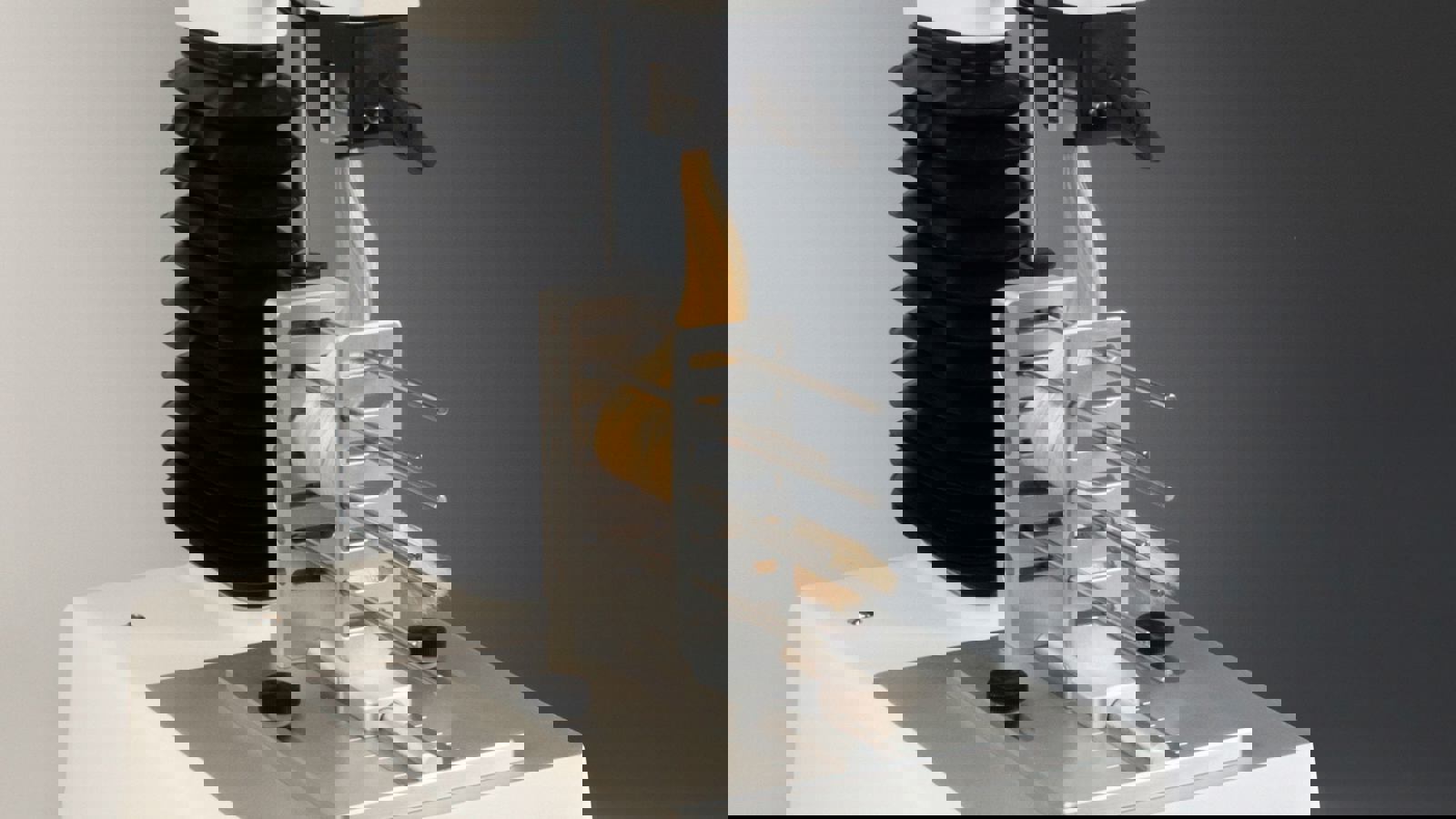
The cosmetics industry frequently promises softer, suppler hair after the use of their products, or promises that certain traditionally harmful methods (such as bleaching) will have no adverse effect. The difficulty comes in testing these properties in an imitative, repeatable way. The Hair Suppleness Rig allows the measurement of the resistance of a hair sample to being run through a set of smooth bars, representative of running fingers through the hair on a human head.
Some changes to the physical properties of hair are intentional (the addition of conditioners or serum for added smoothness), whereas some are unintentional (bleaching, which induces brittleness and stiffness). No matter the property in question, the quantification of hair properties is important to the development of new hair products and treatments. Sensory panels are useful, as hair is a product with a complex pattern of properties and variables, so it is a challenge to measure its properties exactly as a consumer might feel them when they are styling their hair, or what they take to mean ‘softness to the touch’. However, instrumental testing is much faster to perform, and the results of an instrumental test do not rely on the operator, unlike those of a sensory test, no matter how thorough sensory training has been. Consequently, instrumental quantification of hair properties should be a standard part of any hair testing routine.
Assessments of hair such as tensile testing and three-point bend testing are useful for keeping a record of more fundamental properties, but imitative tests such as the measurement of combing force, volume and body measurement via laser profiling, and this suppleness test are useful for representing hair in the way in which it is felt and used in reality.
The force detected by the Load Cell when a hair sample is pulled through this rig is made up of several factors:
- The stiffness of the hair fibres (as they have to constantly bend on their way up through the rods).
- The friction between hair strands (as they rub against each other constantly when the tress is being pulled upward).
- The friction between the hair strands and the rig (as they are pulled against the surface of the rig itself).
An alteration to any of these factors will have an effect on the measured force. A higher force represents a higher resistance to motion through the rods of the rig. A suppler hair sample will have a lower resistance to motion, and in turn, suppler hair on a person’s head feels flexible and smooth when fingers are run through it.
This is similar to subjecting a sample to a three-point bend test, but the bending configuration is slid along the length of the tress- i.e., continuous three-point bending. Bending tests can be challenging to set up in a reproducible way, particularly for suppler samples that cannot support their own weight without drooping, so this test is a simpler alternative that can be directly related to the consumer’s perception of their own hair texture.


