

Measure the mechanical properties of polymers
Explore the different ways in which a Texture Analyser can measure the physical and mechanical characteristics of polymers.
Why measure the mechanical properties of polymers?
The measurement of mechanical properties in polymers is fundamental given the ubiquitous presence of polymers in modern society.
These versatile materials manifest in various forms, such as films, foams, adhesives, coatings, rubbers, composites, textiles, and fibres, serving both functional and cosmetic purposes. Whether natural polymers found in foods, wood, or paper, or synthetic polymers employed as engineering materials, meticulous testing is essential to ensure fitness for purpose.
Polymer research, development, and quality control heavily rely on mechanical property measurements to optimise material selection, design components capable of withstanding application-specific forces, assess part strength and longevity under varying stress conditions, and implement effective quality control checks.
The diversity of polymer properties and applications necessitates a broad spectrum of testing approaches beyond traditional tensile and bend tests, including flexural, compressive, and tensile tests, often in combination to simulate real-world stress states. Imitative measurements allow for more realistic testing scenarios, unconstrained by standard methods, offering testing flexibility and meaningful results.
Time-dependent creep and relaxation properties are of particular interest due to the viscoelastic nature of most polymers, assessed through similar configurations as standard tests but involving hold periods at set stress or strain levels, or cycles at various test speeds.
In essence, the measurement of mechanical properties in polymers underpins their suitability for diverse applications and ensures their performance and quality meet the stringent demands of the modern world.


How a Texture Analyser can be applied to polymer mechanical property measurement?
Polymers, given their extensive use across industries, require a deep understanding of their mechanical properties to ensure they meet specific performance criteria. The use of a Texture Analyser in this context is instrumental. Here's how it benefits the manufacture and development of polymers:
- Comprehensive property evaluation: Texture Analysers can evaluate a wide range of mechanical properties, such as tensile strength, elongation, compression modulus, and flexural strength, offering a holistic view of a polymer's mechanical behaviour.
- Quality assurance and control: Regular testing ensures that produced polymers consistently meet desired specifications, essential for maintaining brand reputation and reducing wastage.
- Optimising formulations: When modifying polymer formulations with additives, fillers, or plasticisers, mechanical testing helps understand their effect on the final product, leading to optimised formulations.
- Predictive modelling and lifetime assessment: By studying how polymers age and degrade over time under various conditions, manufacturers can predict product longevity and performance.
- Regulatory compliance: For polymers used in specific sectors, like medical or food packaging, compliance with set mechanical standards is mandatory. Regular testing ensures adherence to these benchmarks.
- Innovation and novel material development: For researchers developing new polymers or biopolymers, mechanical testing provides critical data to evaluate and compare the potential of these innovative materials.
- Processing parameter optimisation: Mechanical properties of polymers can vary based on processing conditions like temperature, pressure, and shear. Testing allows manufacturers to refine these parameters for desired properties.
- End-use suitability assessment: Different applications demand distinct mechanical properties. For example, a polymer used in a flexible water bottle varies from that in a rigid car bumper. Testing ensures polymers are fit for their intended application.
- Economic efficiency: By understanding the exact mechanical properties required for a specific application, manufacturers can avoid over- or under-engineering polymer products, leading to cost savings.
- Environmental and sustainability evaluations: As the push for recyclable and biodegradable polymers grows, understanding their mechanical properties is crucial to ensure they're viable alternatives to traditional polymers.
- Stress-strain analysis: This aids in understanding the elastic or plastic behaviour of polymers, which can inform design decisions, especially in load-bearing applications.
- Feedback mechanism: Regular testing can serve as feedback for raw material suppliers, ensuring the quality of monomers, additives, and other components.
- Validation of material claims: For polymers marketed with specific claims, such as "high impact resistance" or "superior flexibility", empirical data from a Texture Analyser offers validation.
Incorporating a Texture Analyser in the polymer development and manufacturing process facilitates a data-driven approach. This not only ensures quality and performance but also spurs innovation, aligns with regulatory requirements, and caters to evolving industry demands, all while ensuring efficiency and cost-effectiveness.
Typical measurements
Polymers, both thermoplastics and thermosetting, have diverse applications due to their versatile mechanical properties. Texture analysers are vital tools for measuring and characterizing these properties.
Here are the mechanical properties that can be assessed for polymers using a Texture Analyser:
Texture Analysers, coupled with the appropriate attachments and probes, provide valuable insights into the mechanical performance of polymers. Such data is crucial for research and development, quality control, and application-specific optimisation of polymer materials.
Polymer raw materials also come in powder form. These can be measured using powder measurements such as Powder Flow Analysis, Unconfined Yield Stress and Powder Vertical Shear.
Typical graphs indicating relevant mechanical property parameters


Typical product test and graph
Case studies
Whether its providing the solution for Argenta Innovation to measure the polymer peak strength for their intraruminal device, allowing the Population Council to characterise their polymer for developing a birth control device or offering a method for Akina Inc to measure the tensile strength of their environmentally degradable alkyl polyester patent, a materials testing instrument is adaptable and flexible in its application to measure the bespoke mechanical properties of your product and then enable its quality to be controlled in your manufacturing to guarantee consistency and customer satisfaction.
With deep expertise in physical property measurement of materials, we’re well equipped to support innovation in this sector – just ask our customers.
Probes and attachments for measuring the mechanical properties of polymers
A wide range of probes and attachments can be integrated with our instruments, allowing testing to be precisely adapted to the material or product under evaluation. Applications include compression tests to compare polymer compressive strength, bending tests to assess flexural stiffness or tensile tests to measure and control tensile resilience or material elongation properties.
Over the years, we have collaborated with leading scientists and organisations across diverse industries to design and refine attachments that meet highly specific testing requirements. When a suitable solution does not already exist, we develop one – expanding our portfolio of Community Registered Designs and reinforcing our commitment to innovation in solving complex testing challenges. The Mini Stickiness System is just one example of this.
The examples provided illustrate a selection of specialised attachments and commonly performed measurements in this application area. This list is not exhaustive; a wide range of additional options are available for the testing of food packaging. All instruments in the Texture Analyser range can be used to perform the tests described.
Compression test
Example standards: ASTM D695, ISO 604.
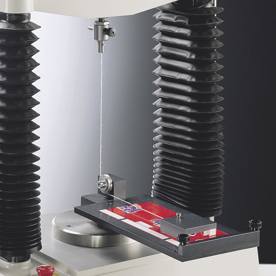
Tensile Test
Example standards: ASTM D638, ISO 527, ASTM D882, ASTM D412.
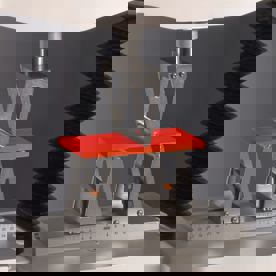
Flexure/Three point bend test
Example standards: ASTM D790, ISO 178.
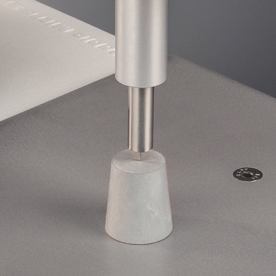
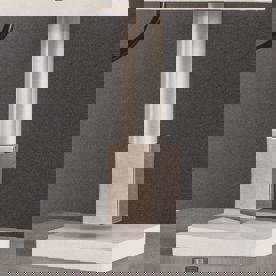
Indentation test using Shore/Brinell/Vickers Hardness Probes
Example standard: ISO 7619-1.
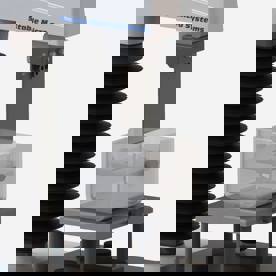
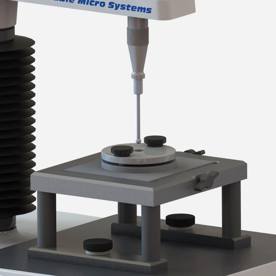
Mini Stickiness System
Viscous polymer stickiness measurement.
Test methods
As with any sample type, there are industry specifications that must be complied with. Many manufacturers, particularly those in consumer, automotive, medical and aerospace industries, choose to test their samples according to standard methods. Exponent Connect software includes a comprehensive range of test methods for polymers (including ASTM and ISO Standards), all instantly accessible at the click of a button. We streamline your texture testing process, ensuring faster access to methods and ready-to-use analysis files for your product properties.
Using the Texture Analyser for new polymer material and product ideas
Polymers, being versatile and adaptable materials, have seen continuous evolution in response to industrial demands, environmental concerns, and technological advances. Here are some of the newer ingredient and product ideas in the polymer sector:
The aforementioned ideas provide an overview of the cutting-edge developments and directions in which polymer science is heading. With global challenges such as environmental concerns and the need for advanced functionalities, polymers will continue to play a crucial role in many industries.
Recent research
Here is some recent interesting research in polymer product development using the Texture Analyser:
- Impact of structural relaxation on mechanical properties of amorphous polymers
- Characterization of hydrophilic polymers as a syringe extrusion 3D printing material for orodispersible film
- 4D printing of biodegradable elastomers with tailorable thermal response at physiological temperature
- Robust polymer foams from 2-hydroxyethyl cellulose: Fabrication, stability, and chemical functionalization
- Rheological and textural properties of hydrogels, containing sulfur as a model drug, made using different polymers types
- Investigation on hot melt extrusion and prediction on 3D printability of pharmaceutical grade polymers
- Effect of starch and hydroxypropyl methylcellulose polymers on the properties of orally disintegrating films


