

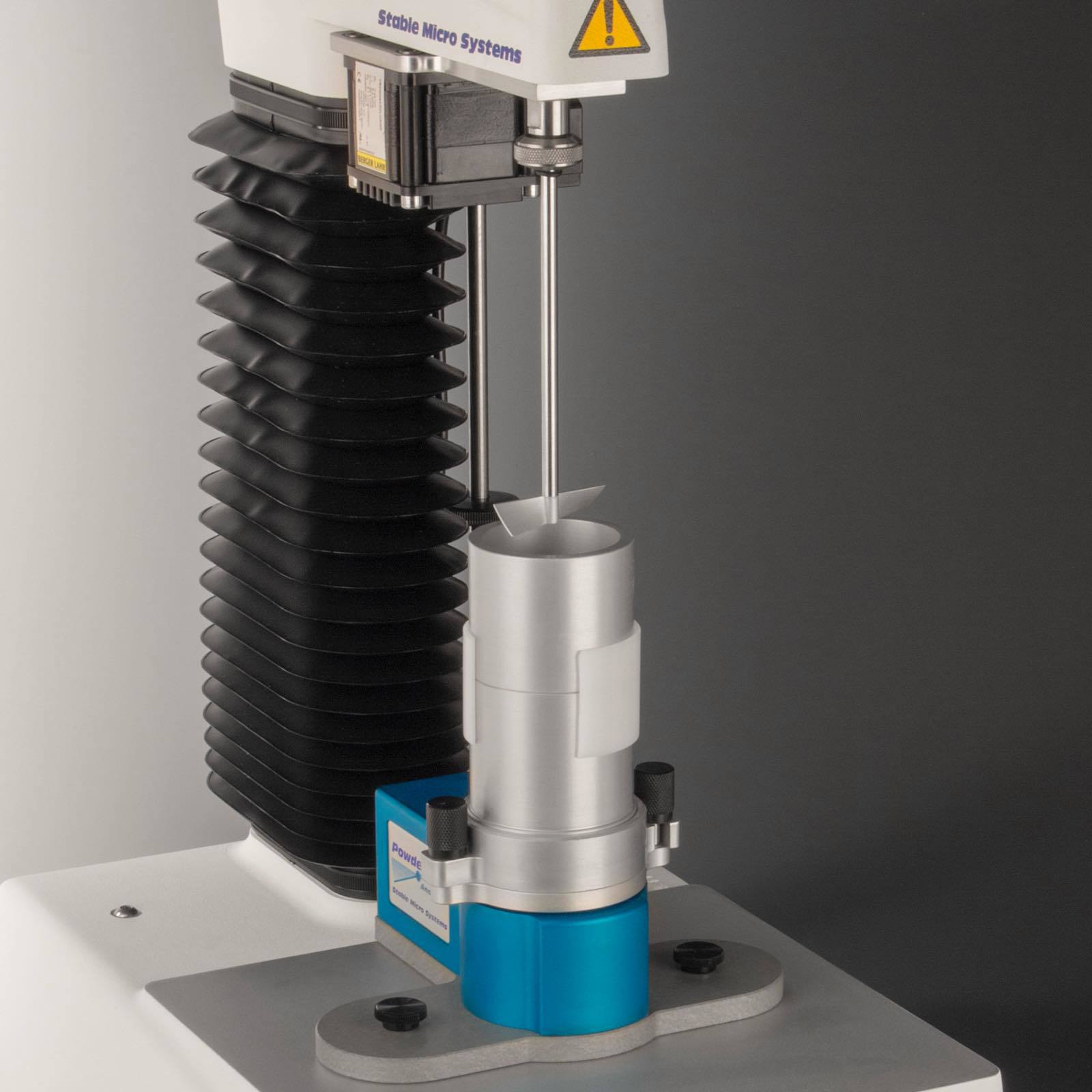
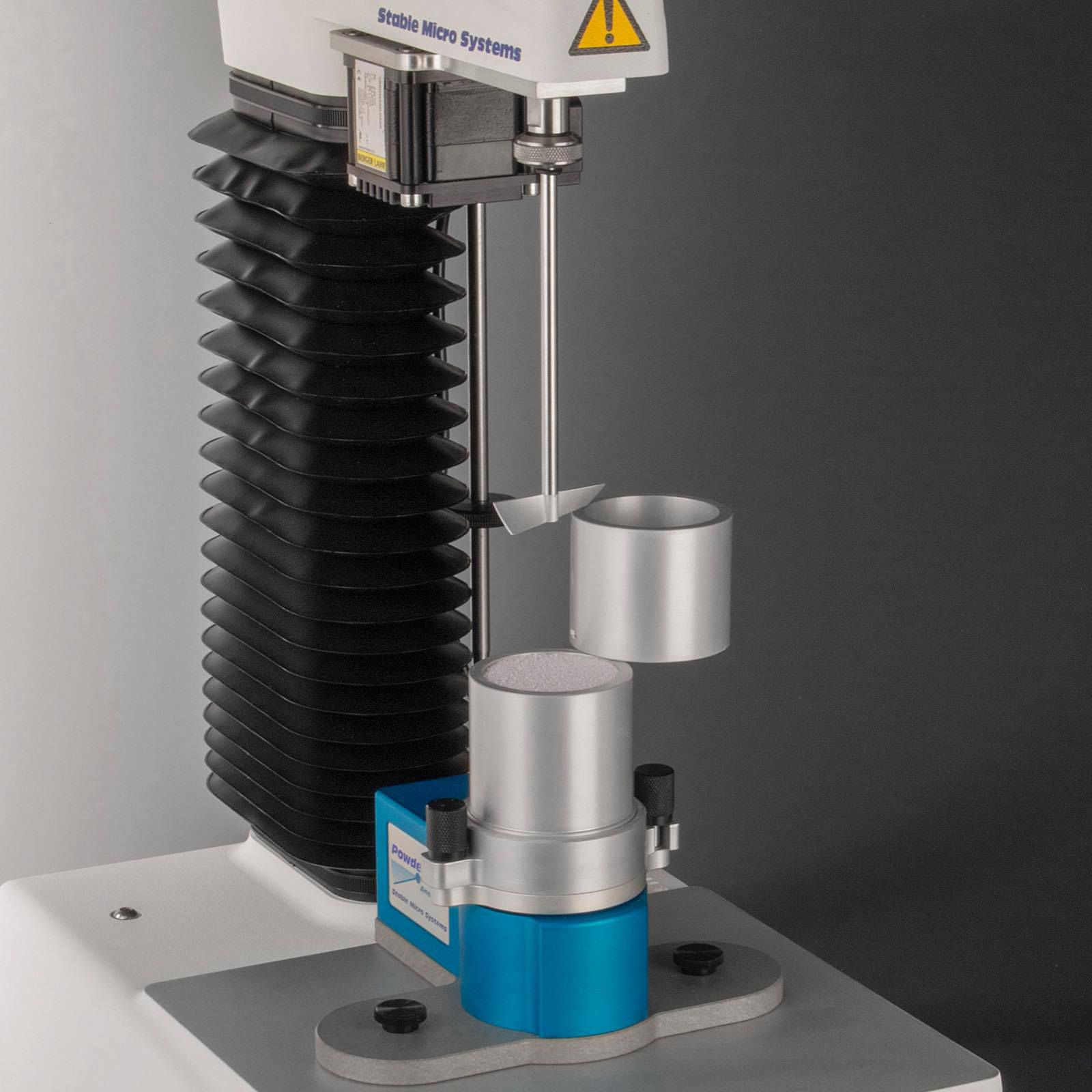

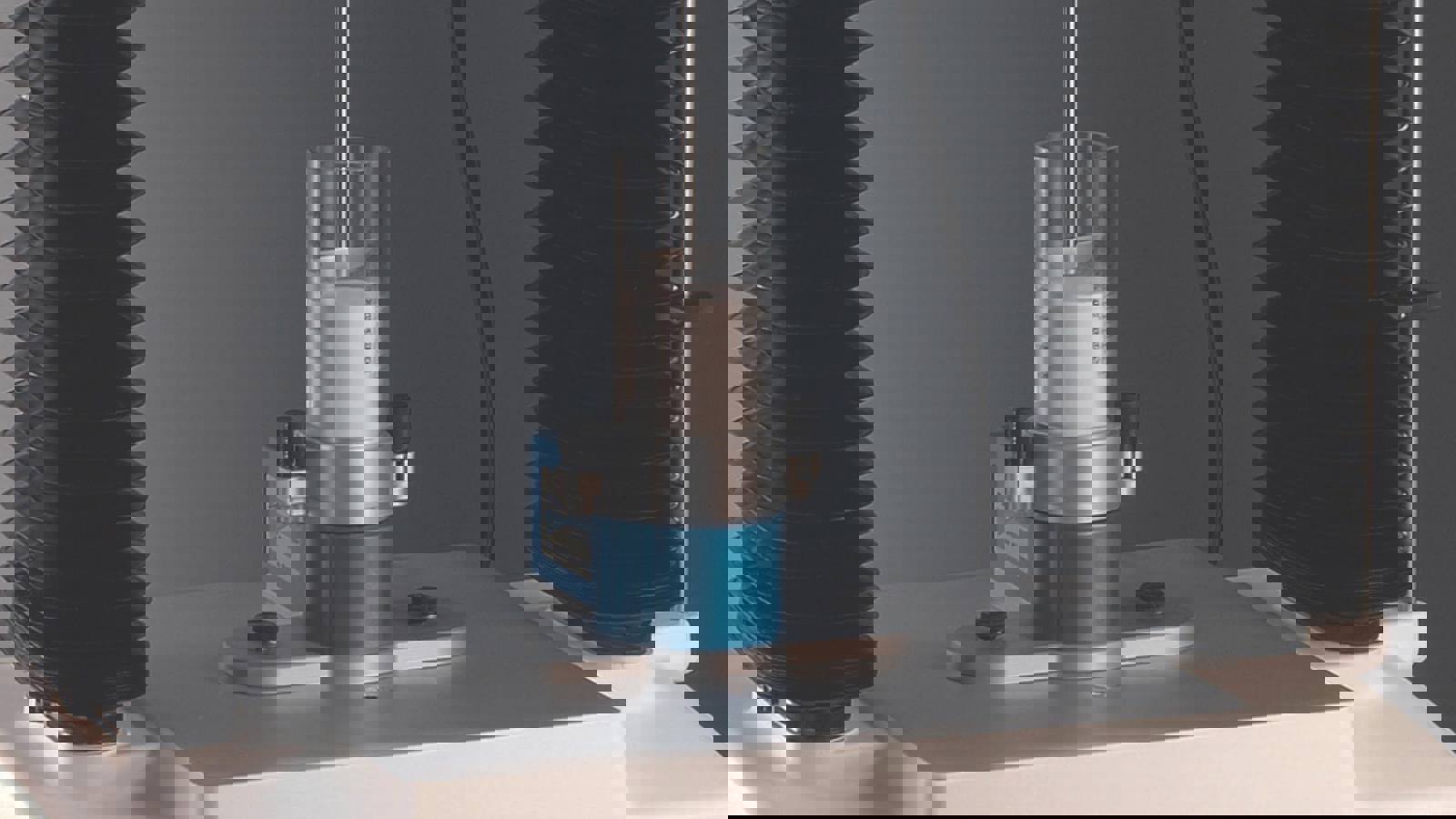
Keeping powders and granules flowing correctly and consistently is critical from ingredient handling and processing through to packing, storage and final use. The Powder Flow Analyser (PFA) is an accessory for the TA.XTplusC Texture Analyser that provides repeatable, sensitive measurements of powder flow, helping you avoid discharge problems, caking, batch variation and costly downtime.
Developed in-house at our headquarters in Godalming, Surrey, UK, the Powder Flow Analyser is used worldwide in food, pharmaceutical, personal care and industrial powder applications.
At a glance
- Accessory for the TA.XTplusC Texture Analyser – make full use of the same test frame for both powders and end products
- Controlled Flow tests – displace powders using programmable slicing, shearing, compacting, mixing and aerating actions
- Measures key powder behaviours – cohesion, caking, bridging, bulk density, compressibility, relaxation, stiffness, elastic recovery and flow speed dependence
- Precision helical blade – engineered rotor for highly repeatable, discriminating measurements
- Exponent Connect software – dedicated powder flow methods, calibration, verification, analysis and reporting
Controlled flow measurement
Powder Flow Analyser in action – closeups, differing samples and range of speeds and blade actions.
The Powder Flow Analyser uses a precision helical blade to move through a column of powder in a controlled way. By combining different movement patterns, you can:
- Impose extremely gentle through to highly aggressive flows
- Imitate the way powders behave in hoppers, feeders, conveyors and storage vessels
- Pre-condition the powder column repeatably at the start of each test to minimise loading differences between operators
During each test, the system measures axial force, time and distance, and Exponent Connect software analyses the data to characterise how the powder responds under those specific conditions.
Apply multiple actions in one test
User-programmable test sequences allow you to combine:
- Slicing and shearing – to move through the powder column with minimal disturbance
- Compacting and compressing – to investigate caking and consolidation behaviour
- Lifting and aerating – to assess how powders loosen and re-flow after compaction or storage
- Mixing actions – to simulate the repeated movement seen in many processes
Any of these actions can be combined and repeated in any order to reflect real-world handling conditions and highlight differences between materials.
Measure multiple powder characteristics
From a single instrument you can:
- Quantify cohesion and caking tendencies
- Assess bridging and flow stoppage risks
- Measure bulk density, compressibility and relaxation
- Characterise stiffness and elastic recovery of compacted beds
- Evaluate powder flow speed dependence – how behaviour changes as conveying or discharge rates increase
These insights help you choose suitable ingredients, tune formulations, set process windows and design packaging that supports consistent performance.
Superior engineered rotor design for accurate results
At the heart of the Powder Flow Analyser is a precision helical blade, engineered to a mathematically defined true helix shape and manufactured to tight tolerances. This design allows the blade to cut through the powder column smoothly and predictably, supporting highly reproducible and sensitive measurements from rotor to rotor compared with simpler, bent-plate blade designs.
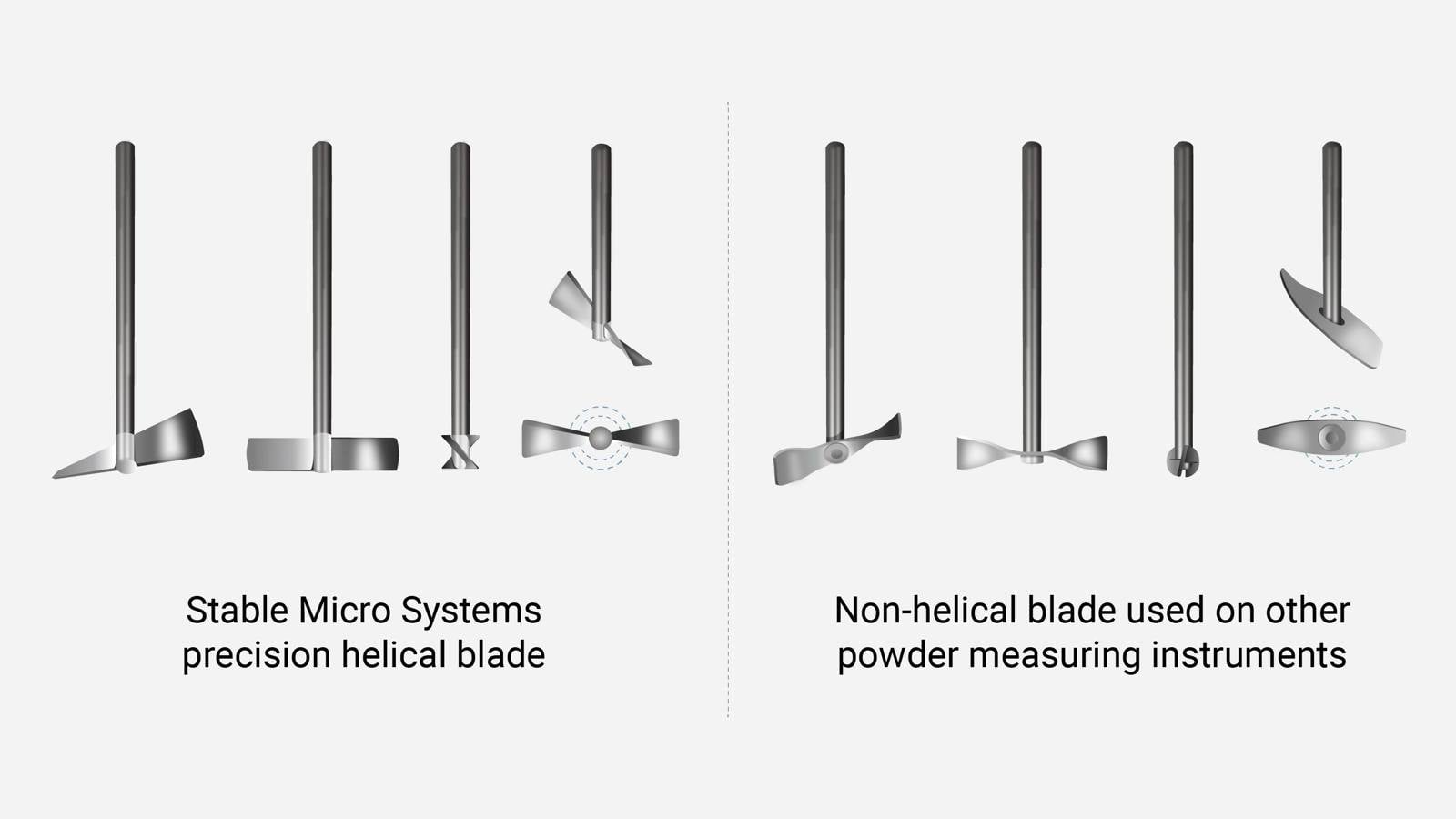 Comparison with competitive blade design
From an engineering perspective
Commenting on the blade, Jim Walker, Founder and Director at Stable Micro Systems, says: "The design of the blade is the single most important factor in achieving repeatable powder flow measurements. The non-helical blade used on other instruments is bent from a flat sheet and presents a large flat central area to the powder being tested. It effectively compresses a column of powder beneath the blade during its travel path through the sample. As a consequence, any axial force readings being taken are corrupted and these instruments are forced to rely on torque measurements because of the inadequacies of blade design."
As the blade moves, it naturally cuts through the powder column along its helical path. This means the powder is displaced in a controlled fashion and the forces acting on the blade can be measured directly as axial force, without relying on complex torque-only measurements.
The result is a system capable of delivering:
- Highly reproducible results between tests and between instruments
- High discrimination between powders that may look similar but behave differently in process
- A strong link between laboratory measurements and real-world flow behaviour
Features and benefits of the Powder Flow Analyser
The Powder Flow Analyser turns your TA.XTplusC Texture Analyser into a multi-purpose powder testing platform – replacing separate devices for flow, caking, compressibility and end-product testing, with one software environment and one training curve.
Data you can trust
Rank suppliers, compare formulations and investigate flow problems with confidence.
The result: The confidence to make evidence-based decisions about suppliers, formulations and process changes.
How it works:
- Conditioning: Pre-conditioned columns reduce variability from sample loading.
- Geometry: Precision-manufactured rotors and vessels keep results consistent run to run.
- Sensitivity: High-speed data capture and Exponent Connect reveal small but critical differences between samples.
One platform, complete coverage
From ingredient powder to finished product – without buying new instruments.
The result: One platform that replaces several separate instruments across your entire testing workflow.
How it works:
- Extension: Add compressibility, cake strength, yield stress and shear fixtures as needed.
- Coverage: Same frame handles powder flow, product tests and finished-product texture.
- Integration: Shared robust frame and vertical drive with your existing Texture Analyser.
Practical in real lab conditions
Designed for QC and R&D teams who need fast, repeatable results every day.
The result: Tests that fit real workflows: representative sample sizes, fast cleanup, short learning curve.
How it works:
- Sample sizes: 20–200 ml volumes suit both R&D and routine QC without wasting costly powders.
- Cleaning: Smooth surfaces and simple geometries mean fast turnaround between tests.
- Onboarding: Library projects in Exponent Connect get new users producing results with minimal training.
Solve real powder problems
Identify and fix caking, bridging and discharge issues before they reach production.
The result: Catch potential failures before the line, and support process changes with data, not guesswork.
How it works:
- Prevention: Identify batches likely to cake, bridge or block equipment.
- Optimisation: Minimise lumps, segregation and discharge issues through data-led decisions.
- Confidence: Support higher throughput or new formulations with evidence, not trial and error.
This makes the combined system one of the most versatile testing solutions available for both powders and finished products – effectively replacing several separate instruments with a single, integrated platform.
Where is the Powder Flow Analyser used?
The Powder Flow Analyser is used by R&D, formulation and QA/QC teams in:
- Food and beverage – flours, cocoa and chocolate powders, sugars, milk powders, drink mixes, spices, seasonings, instant products
- Pharmaceutical and nutraceutical – APIs, excipients, granules, blends, capsule and tablet powders
- Home and personal care – detergents, cleaning powders, cosmetic powders and talcs
- Industrial and chemical – pigments and colourants, metal powders, ceramics, fertilisers and other bulk solids
It is equally valuable for development work (exploring new recipes and processes) and routine monitoring of powder performance in production.
What is included with a Powder Flow Analyser system?
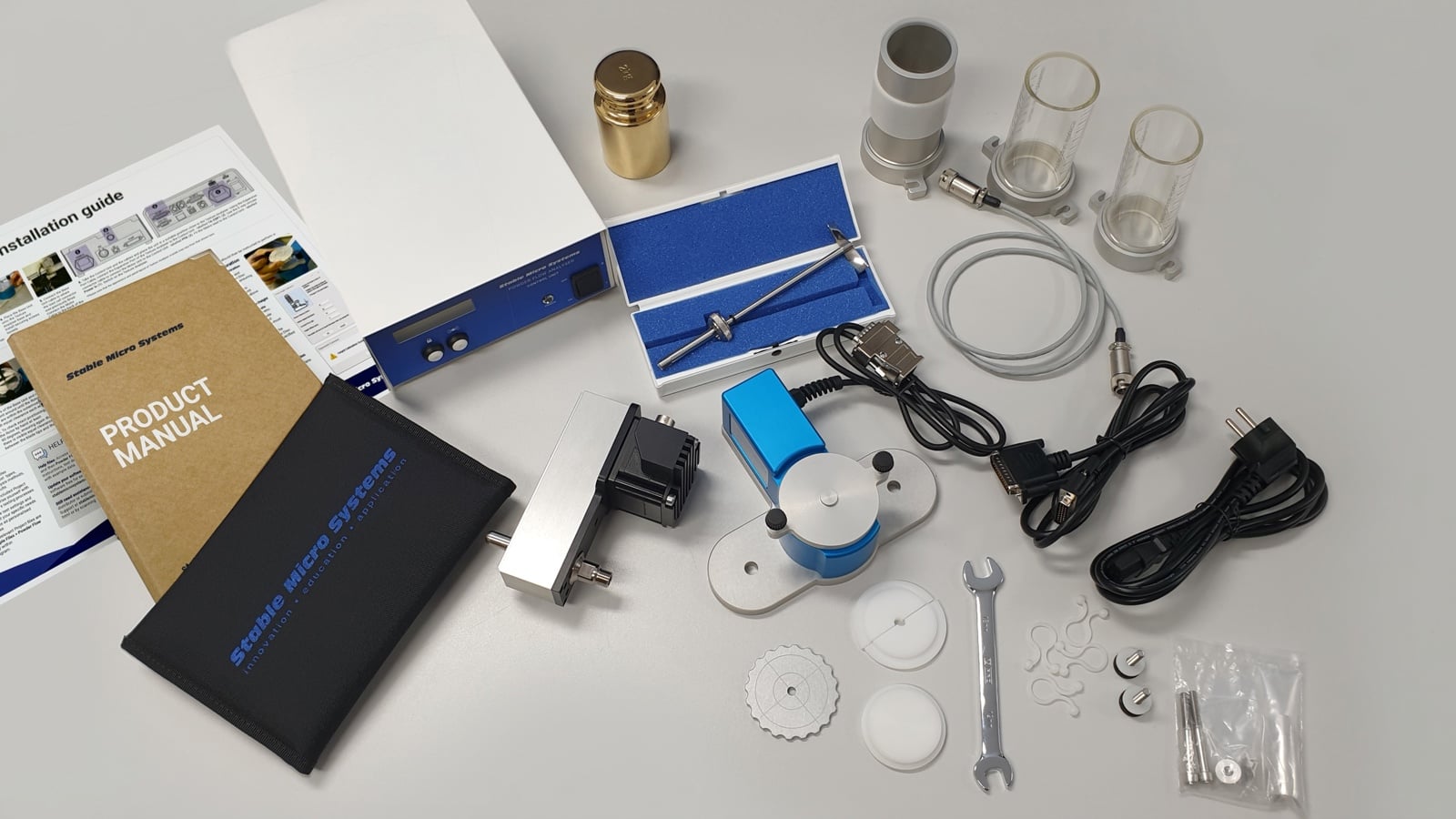
- Control Unit/Interface Module
- Base Unit
- Base Unit Screws and Washers x2
- Power Lead
- TA.XTplus Expansion Cable
- Motor Cable
- Motor Drive Unit
- Cable Clips x2
- Calibration Disk
- Rotor (48mm or 23mm diameter according to order)
- Vessels (50mm or 25mm according to order) x3
- Vessel Lids (1 closed, 1 open) x2
- 2kg Calibration Weight
- Manual
- Installation Toolkit (for TA load cell reinstallation)
- HD Adapter Kit (if required)
- 12mm Spanner
- PFA Installation Guide Chart
Accessories for the Powder Flow Analyser
The Powder Flow Analyser can be configured with a range of vessels, blades and complementary fixtures to extend your powder property measurement options.
Test vessels


50mm ⌀ Split Vessel and Base

50mm ⌀ Glass Vessel and Base

25mm ⌀ Glass Vessel and Base

50mm ⌀ Glass Vessel and Base (set of 3)

25mm ⌀ Glass Vessel and Base (set of 3)
Standard vessels hold the powder or granular samples for testing and are manufactured from precision borosilicate glass for dimensional stability and easy inspection.
- Precision borosilicate glass tube with removable acetal base attachment ring
- Two standard diameters covering typical test volumes from around 20ml to 200ml
- Vertical alignment and radial tolerance typically better than ±0.05mm
- Alternative materials and custom sizes available on request
- Available individually or as sets (for higher-throughput work or multi-batch comparisons)
| Vessel sizes | |
| Approximate capacity | Nominal diameter |
| 45ml | 25mm |
| 200ml | 50mm |
| 200ml (split vessel) | 50mm with split body for easy removal and weighing of conditioned powder for bulk density tests |
Rotors and blades

48mm Rotor

23mm Rotor
|
Blades are designed specifically for ‘Controlled Flow’ testing and are manufactured to tight tolerances to ensure repeatable powder displacement. |
|
| Blade material | Selective Laser Sintered (DMLS) 316 stainless steel, polished to an approximate surface roughness of Ra 0.5µm |
| Rotor shaft | 6mm diameter 316 stainless steel |
| Standard blade sizes |
23.0mm diameter × 10mm height |
Rotors provide the controlled powder flow that underpins powder flow analysis. Carefully designed blade geometry and shaft alignment allow you to:
- Impose slicing, shearing, lifting, compacting and mixing actions
- Measure how powders respond, including caking, cohesion and flow speed dependence
- Repeat test sequences accurately from batch to batch
- Alternative blade materials and custom geometries may be available for specific applications; contact Stable Micro Systems or your local distributor for details.
Alternative blade materials and custom geometries may be available for specific applications; contact Stable Micro Systems or your local distributor for details.
For more complex powder behaviour studies, the Powder Flow Analyser can be combined with additional fixtures such as split vessels, compressibility probes and caking or yield-stress rigs, described on the Other powder-related tests page.
Other accessories

Probe Adapter for PFA Motor to M3 Male

Compression Probe for PFA 48mm diameter vessel
Technical specification
|
Movement and measurement performance The Powder Flow Analyser uses the vertical drive of a Texture Analyser together with a rotational drive to move a helical blade through a column of powder. Key performance details include: |
|
| Maximum vertical force (downwards) | 5kg (50N) |
| Maximum vertical force (upwards) | 5kg (50N) |
| Force resolution | ±0.5% |
| Force zero hysteresis | < ±0.2g |
| Rotor tip speed | 23mm Blade | 48mm Blade |
| Tip speed | Depends on the programmed test angle | Depends on the programmed test angle |
| At 0° (pure rotation) | From stationary up to approximately 350mm/s | From stationary up to approximately 754mm/s (maximum rotational speed 300rpm) |
| At 90° (pure vertical movement) | Around 40mm/s* | Around 40mm/s* |
| Vertical travel | |
| Minimum vertical travel | 180mm* |
| Data acquisition | |
| Data collection rate | Up to 2000 points per second, allowing detailed force-time and force-displacement curves for analysis in Exponent Connect software. |
*Values may differ slightly depending on the Texture Analyser model used.
|
Operating conditions The PFA is designed for routine laboratory and production use. |
|
| Environmental protection | Dust- and splash-resistant design for typical lab/plant environments |
| Operating temperature range | 0 – 40°C |
| Always allow instruments and powders to reach a stable temperature before critical measurements. | |
|
Power requirements The Powder Flow Analyser shares the power requirements of the host Texture Analyser. |
|
| Supply voltage range | 90-264 VAC |
| Input frequency range | 47-63 Hz |
| Always refer to the nameplate and the main Texture Analyser manual for full safety and power information. | |
|
Complete system content Powder Flow Analyser systems vary depending on the vessel diameter. |
|
| 50mm diameter vessels | 25mm diameter vessels |
| 1 x 48mm diameter rotor | 1 x 23mm diameter rotor |
| 2 x glass vessels | 3 x glass vessels |
| 1 x aluminium split vessel | |
Dimensions
All Powder Flow Analyser components (rotational drive, vessels, blade and mounts) are contained within the standard working envelope of the Texture Analyser frame, with an additional control unit which sits alongside and requires bench space of approximately W197.5 x H87 x D380 next to the host instrument.
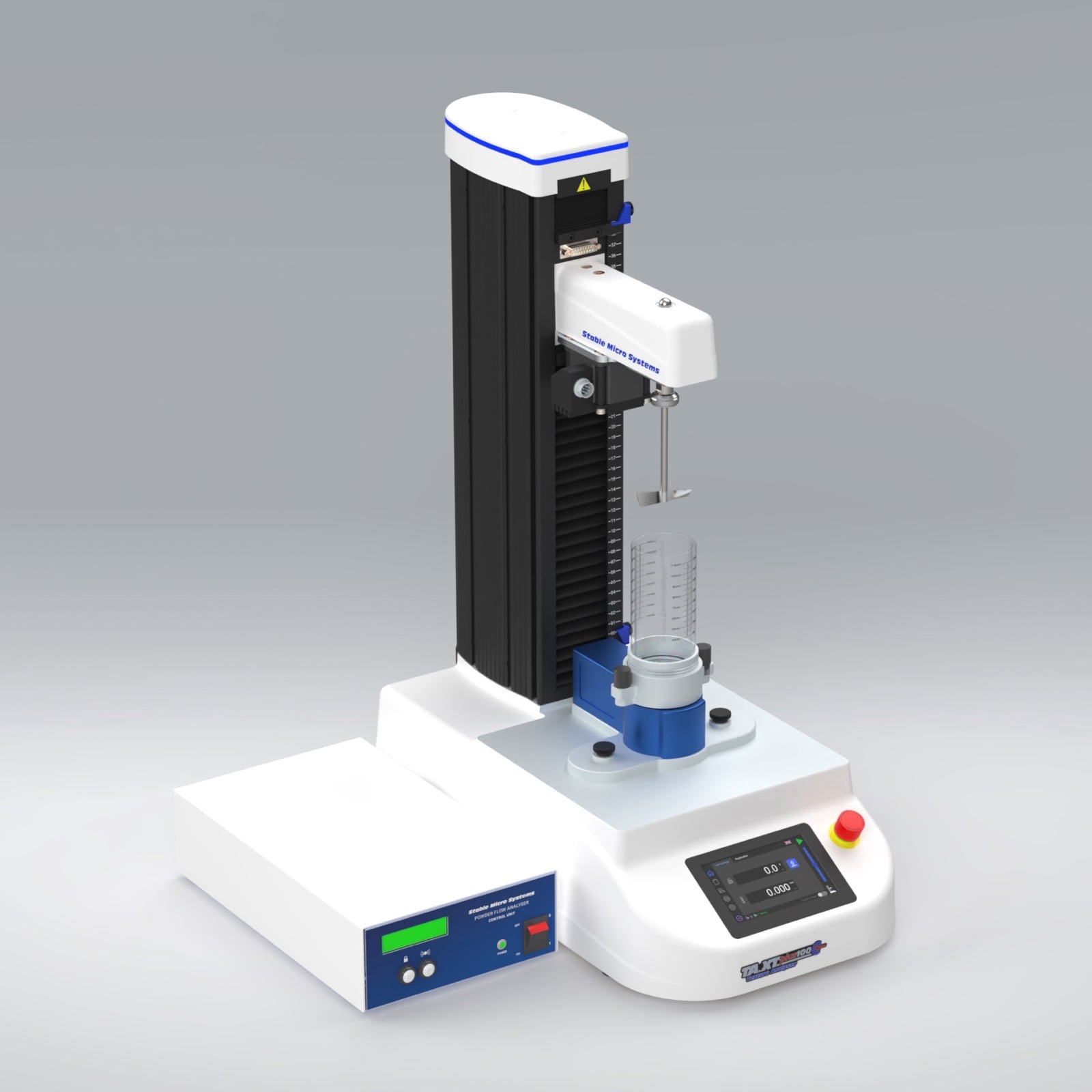 Powder Flow Analyser and Control Unit
Additional technical information
For deeper technical background and validation:
Published papers using the Powder Flow Analyser
A curated list of peer-reviewed studies showing PFA applications across food, pharma, cosmetics, industrial and other sectors.
Patents referring to the Powder Flow Analyser
Documentation of the underlying technology and methods used for Controlled Flow measurement.
Installation guide
Existing customers can request an A3 installation and quick-reference poster to support correct setup and routine use of the Powder Flow Analyser.
Why choose a Stable Micro Systems product?
When you invest in a Stable Micro Systems Powder Flow Analyser, you’re choosing more than an instrument.


Our customers consistently cite our technical knowledge and willingness to help solve complex testing challenges as key reasons they choose our instruments again and again.

FAQs about the Powder Flow Analyser
What does the Powder Flow Analyser actually measure?

The Powder Flow Analyser measures axial force, time and distance as a helical blade moves through a column of powder under controlled conditions. Exponent Connect software then calculates powder flow parameters that relate to cohesion, caking, flow stability, compressibility and the influence of flow speed.
Can I retrofit a Powder Flow Analyser to an existing Texture Analyser?
Yes. In many cases you can add a Powder Flow Analyser to an existing TA.XTplusC Texture Analyser, extending its capabilities into powder flow testing. Your local distributor or Stable Micro Systems representative can advise on compatibility and any additional accessories required.
What kind of operator training is needed?
Most users can begin running standard powder flow tests after a short training session using the supplied projects in Exponent Connect software. More advanced method development and data interpretation can be supported through our application notes, Education Zone resources and direct technical support.
How does the Powder Flow Analyser compare with other powder testers?
The PFA combines a precision helical blade, axial force measurement and flexible, programmable movement to provide highly reproducible data across a wide range of powders. Because it mounts on a TA.XTplusC Texture Analyser, it also offers broader test capability than many stand-alone powder testers.
Which Texture Analysers is the Powder Flow Analyser compatible with?
The Powder Flow Analyser is designed to mount on a TA.XTplusC Texture Analyser and other compatible Connect series models with the appropriate fittings. If you already own a Stable Micro Systems instrument and are unsure about compatibility, your local distributor or Stable Micro Systems can confirm whether your system can be upgraded with a Powder Flow Analyser.
How much vertical force does the system apply during a test?
During powder flow analysis, vertical forces are typically within the range required to move the helical blade through the powder column under controlled conditions. The host Texture Analyser provides up to 5 kg (50 N) of upward and downward force in standard configurations, which is more than sufficient for the conditioning and compaction steps used in routine powder flow tests.
What sample volumes can the Powder Flow Analyser handle?
Standard vessels cover approximate volumes from around 45 ml (25 mm internal diameter) up to 200 ml (50 mm internal diameter), plus a 200 ml split vessel used for bulk density measurements. This allows you to work with small quantities of expensive materials while still having enough sample to be representative of real handling conditions.
How fast can the rotor move through the powder?
Rotor tip speed depends on blade size and test angle. With a 48 mm blade, tip speeds range from stationary up to around 754 mm/s at a 0° test angle (maximum 300 rpm), and around 40 mm/s at 90° where movement is primarily vertical. These ranges allow you to simulate gentle, slow movement through to more aggressive flow conditions, as required by your application.
Do I need a separate power supply for the Powder Flow Analyser?
No. The Powder Flow Analyser is powered via the host Texture Analyser and shares its mains supply. Typical supply requirements are 90–264 VAC at 47–63 Hz. Always refer to the nameplate and the Texture Analyser manual for full safety and power information.
Can I use different vessel sizes or blade geometries than the standard ones?
Standard configurations include two main vessel sizes and two standard blade diameters. In many cases this covers the majority of applications. However, alternative materials and custom vessel or blade geometries may be available for specific requirements, for example when working with particularly aggressive products or unusual sample volumes. If you have a specialist need, contact Stable Micro Systems to discuss custom options.
How does data acquisition rate affect my tests?
The data acquisition rate (up to 2000 points per second when using Exponent Connect) determines how finely force and position are sampled during a test. Higher rates allow more detailed force-time and force-displacement curves, which can improve the sensitivity of your measurements and help identify subtle differences in powder behaviour, especially in dynamic or rapidly changing parts of the test sequence.