

Product overview
Pizza – be it frozen, fresh, take-out or served in a fancy restaurant – is a classic success story. A humble Italian ethnic speciality, it transformed itself into a staple of the Western diet, assuming a myriad of forms and flavours. The process continues as manufacturers find technical, distribution and flavour improvements that keep pizza a favourite food, answering consumers’ needs for comfort and variety. By continuing to reinvent itself, pizza stays current with consumers and dominant in the fresh and frozen food aisles. The rising-crust and stuffed crust innovations, for example, has provided an eat-at-home pizza product with similar quality and taste to the ready-to-eat or pizzeria pizza for considerably less money.
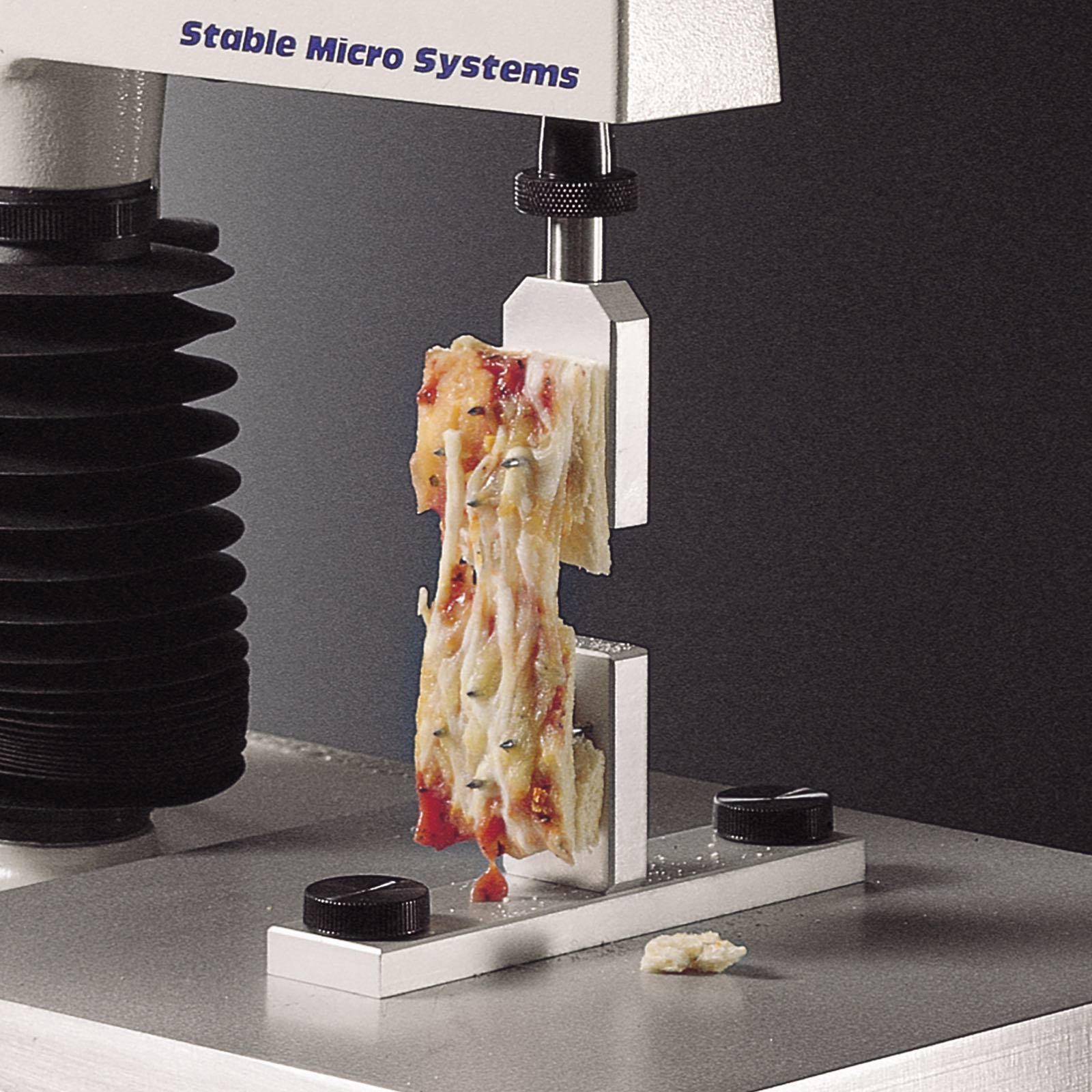
Consumers typically bite well into a slice of pizza then tear or rip the remainder with their teeth. The pizza’s resistance to the teeth’s cutting action, as well as its resistance to the tearing/ripping action contribute to the consumer’s perception of the pizza toughness. The Pizza Tensile Rig was developed for the assessment of this tug (tensile strength) to provide an indication of toughness.
As usual, the difficulty with any tensile testing arrangement is the manner of holding the sample correctly in order to perform the test without the sample failing where it is gripped or held down. The rig comprises of two four-pronged attachments. The upper attachment fits directly to the Load Cell and the lower to the base of the Texture Analyser. The rectangular shaped test sample is carefully positioned vertically on the attachments using the prongs so as not to introduce any cracks. The diamond arrangement of the prongs spreads out the forces so that the pizza will tear in between the two pin sets when the upper and lower prongs are separated. The tensile force and extension to break the sample is measured and used as an indication of pizza toughness.
This attachment has also been used successfully to mount raw fish fillets in order to measure fillet gaping.
How does the Pizza Tensile Rig work?
Typical graph

Ideal sample form
A solid material which can be mounted on a series of spikes without major deformation of the sample piece.
Benefits and limitations
- A sample strip can be held successfully in order to measure tensile strength to pull apart.
- Sample needs to be able to mounted on spikes.
Technical information
Troubleshooting
The upper and lower grips must be started at least 1mm apart. If the test starts with the grips touching a force offset will be created.
