

Typical powder flow problems
A guide to typical powder behaviour issues.

|
The Powder Flow Analyser (PFA) sits directly on a Texture Analyser to operate – which means every PFA customer automatically has a full texture analysis capability at their disposal too. Remove the PFA attachment and you have a precision instrument capable of measuring the mechanical properties of your powders and end products: cake strength, particle robustness, compacted bed behaviour, and much more. This combination gives you a level of powder and product characterisation that standalone powder flow instruments simply cannot match. Throughout this page, alongside the PFA tests that investigate each problem, you'll find the additional Texture Analyser tests your instrument can perform – because understanding a powder problem fully often means looking at it from both angles. |
Most powder handling problems fall into a small number of repeatable failure modes. Recognise your problem below – each section describes what it looks like in practice and points you to the PFA tests that investigate it.
Not sure which problem you have? See the diagnostic guide.
Hopper/bin discharge problems
Flow stops, surges, or behaves unpredictably at the outlet.
Arching/bridging
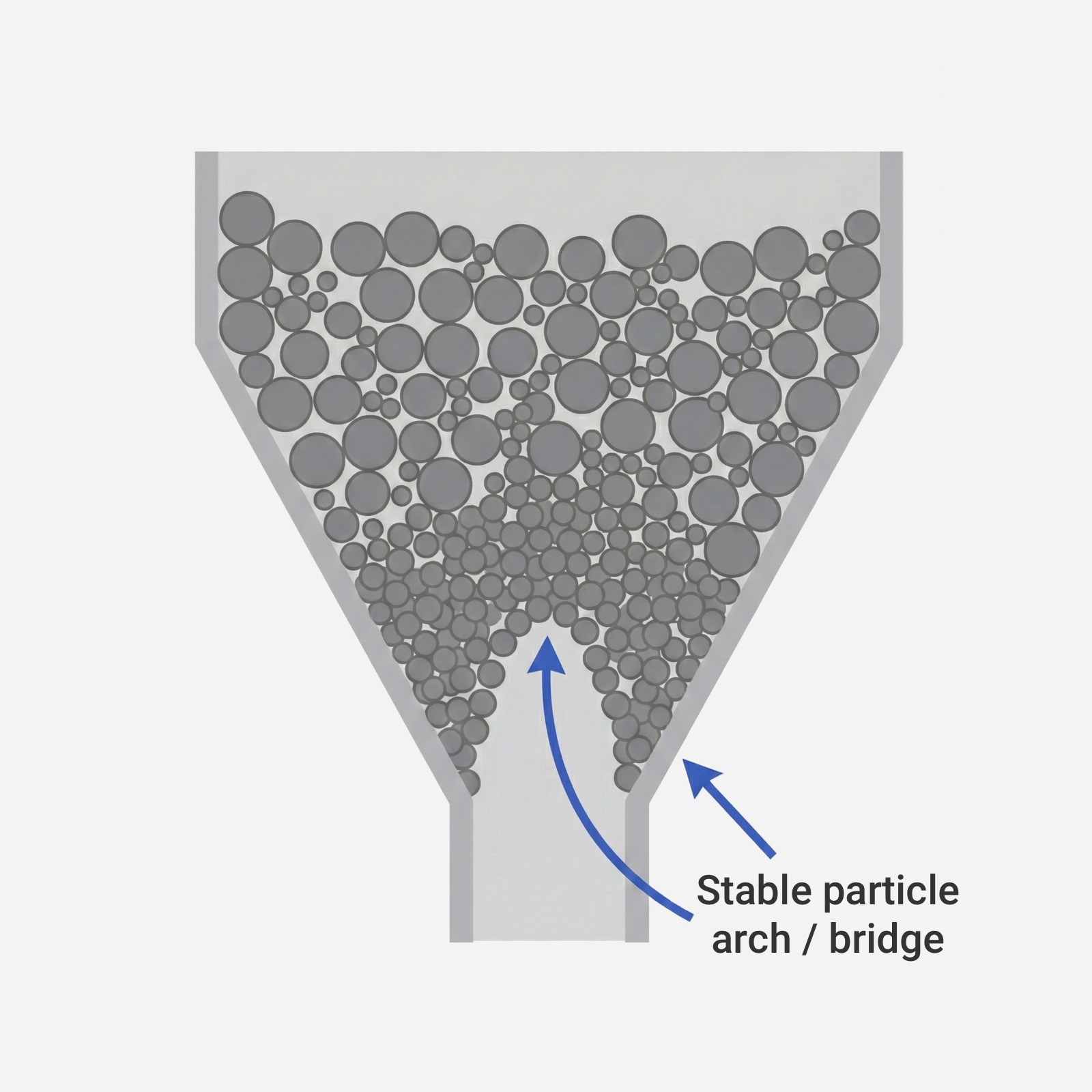
What it is
The powder forms a self-supporting arch across the hopper outlet and flow stops - even with plenty of material above. Sometimes a knock restarts it; sometimes it doesn't.
What it looks like
- Hopper was flowing normally, then stops suddenly
- A stable 'roof' of powder is visible above the outlet
- A single knock or tap causes flow to resume
- Problem is worse after a period of rest or storage
Investigate with
- Cohesion (1 speed) – If the Bridging Factor is high this is a strong indicator of arching/bridging tendency (instability and event-like behaviour).
- Cohesion (4 speeds) – If the Cohesion Index is high this suggests cohesive bonding that supports a cohesive arch.
- Powder Consolidation and Caking – If caking/consolidation is high the arching risk often increases after storage.
Your Texture Analyser can also investigate this
Remove the PFA and your instrument measures the mechanical side of the same problem.
Texture analysis helps quantify the mechanical strength of arches and agglomerated structures once they have formed. Cake strength and break tests measure the force required to fracture cohesive powder structures, supporting assessment of how easily a bridge or arch may collapse under vibration or mechanical intervention.
Technical explanation

Bridging and arching are closely related terms which prevent consistent powder discharge, most commonly leading to downtime, reduced throughput, and safety risks from manual intervention. These issues are strongly influenced by inter-particle cohesion and powder structure, which are not captured by simple flow classifications. Quantifying cohesion under controlled conditions helps identify powders prone to forming stable flow obstructions before problems occur in production.
Why it happens
Two main causes:
- Cohesive arch (fine, sticky, moist, electrostatic powders): particles "bond" enough to hold a bridge.
- Mechanical interlocking arch (granules, irregular particles): particles wedge and lock together like a pile of rough rocks.
Ratholing
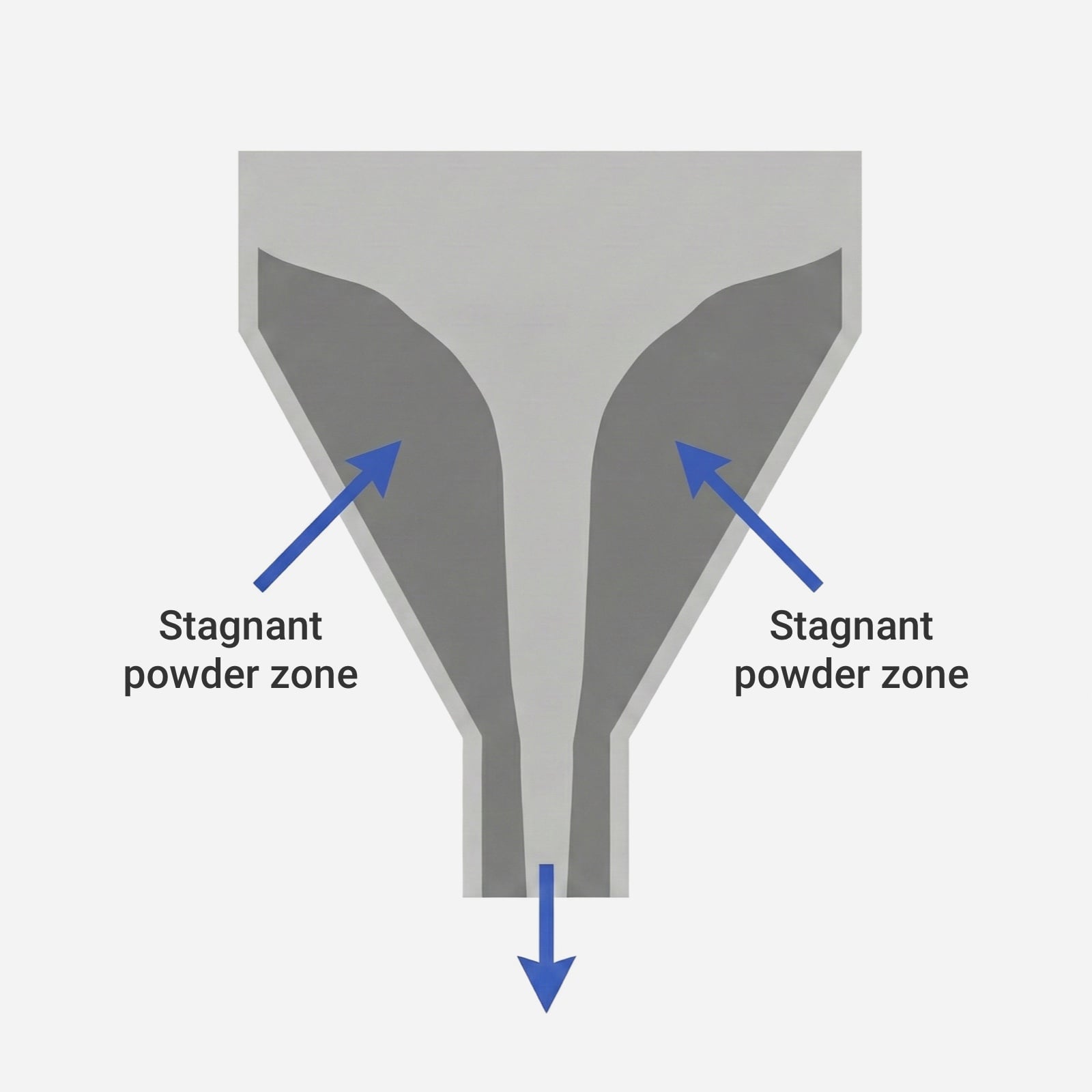
What it is
A narrow flow channel forms above the outlet while powder near the walls stays stuck. The hopper appears to be emptying but isn't - until a sudden collapse causes a surge.
What it looks like
- The hopper level doesn't drop uniformly - a central channel empties but sides stay full
- A stable empty 'pipe' is visible inside the vessel
- Discharge is erratic, with occasional large surges when the rathole collapses
- Often worse with cohesive powders or after consolidation during storage
Investigate with
- Cohesion (1 speed) - If there is a High Bridging Factor and high consolidation/caking this often aligns with a ratholing risk.
- Powder Consolidation and Caking
- Compressibility - If Compressibility is high this supports "will consolidate and become self-supporting."
Your Texture Analyser can also investigate this
Remove the PFA and your instrument measures the mechanical side of the same problem.
Ratholing is influenced by the strength of the stagnant powder mass surrounding the flow channel. Uniaxial compression and cake strength tests help quantify powder bed strength under load, indicating whether sidewall material is likely to remain stable or collapse during discharge.
Technical explanation
Ratholing occurs when powder flows only through a narrow channel while material at the sides remains stationary, reducing effective capacity and causing unpredictable discharge. This can lead to erratic feed rates, incomplete emptying, and sudden collapse of stagnant material. Understanding powder cohesion and consolidation behaviour helps identify materials prone to ratholing and supports better hopper design and handling strategies.
Why it happens
- Powder near walls becomes stagnant due to friction and consolidation.
- The material supports itself like a weak solid.
- Often worse with cohesive powders and consolidation during storage.
Flooding/flushing during discharge

What it is
The powder discharges in an uncontrolled, liquid-like way - surging, spilling, or generating dust clouds. Feed rate control is lost entirely.
What it looks like
• Sudden uncontrolled discharge after vibration or agitation
• Large surges that overwhelm downstream equipment
• Dust clouds at the outlet
• Most common with very fine or light powders
Investigate with
- Cohesion (1 speed) – Characterises the low resistance and weak internal structure typical of flooding-prone powders.
- Powder Flow Speed Dependence (PFSD) – Identifies how flow behaviour changes with speed, revealing aeration effects and the risk of sudden uncontrolled discharge at higher rates.
- For powders where air entrainment is the primary driver, an aeration/permeability add-on test can extend the analysis further.
Your Texture Analyser can also investigate this
Remove the PFA and your instrument measures the mechanical side of the same problem.
Flooding is associated with low mechanical strength and poor resistance to deformation. Texture analysis can quantify weak powder structures using low compression strength or penetration resistance, helping distinguish powders prone to uncontrolled flow once aerated or disturbed.
Technical explanation
Flooding or flushing happens when powders discharge uncontrollably, often after aeration or vibration, leading to loss of control over feed rate and potential downstream overfilling. This behaviour can cause process upsets, material waste, and safety risks. Characterising how powders respond to conditioning, aeration, and speed changes helps predict and prevent uncontrolled flow during discharge.
Why it happens
Common with:
- very fine powders that hold air,
- powders that become fluidised when disturbed or aerated.
Segregation (even if flow is “good”)
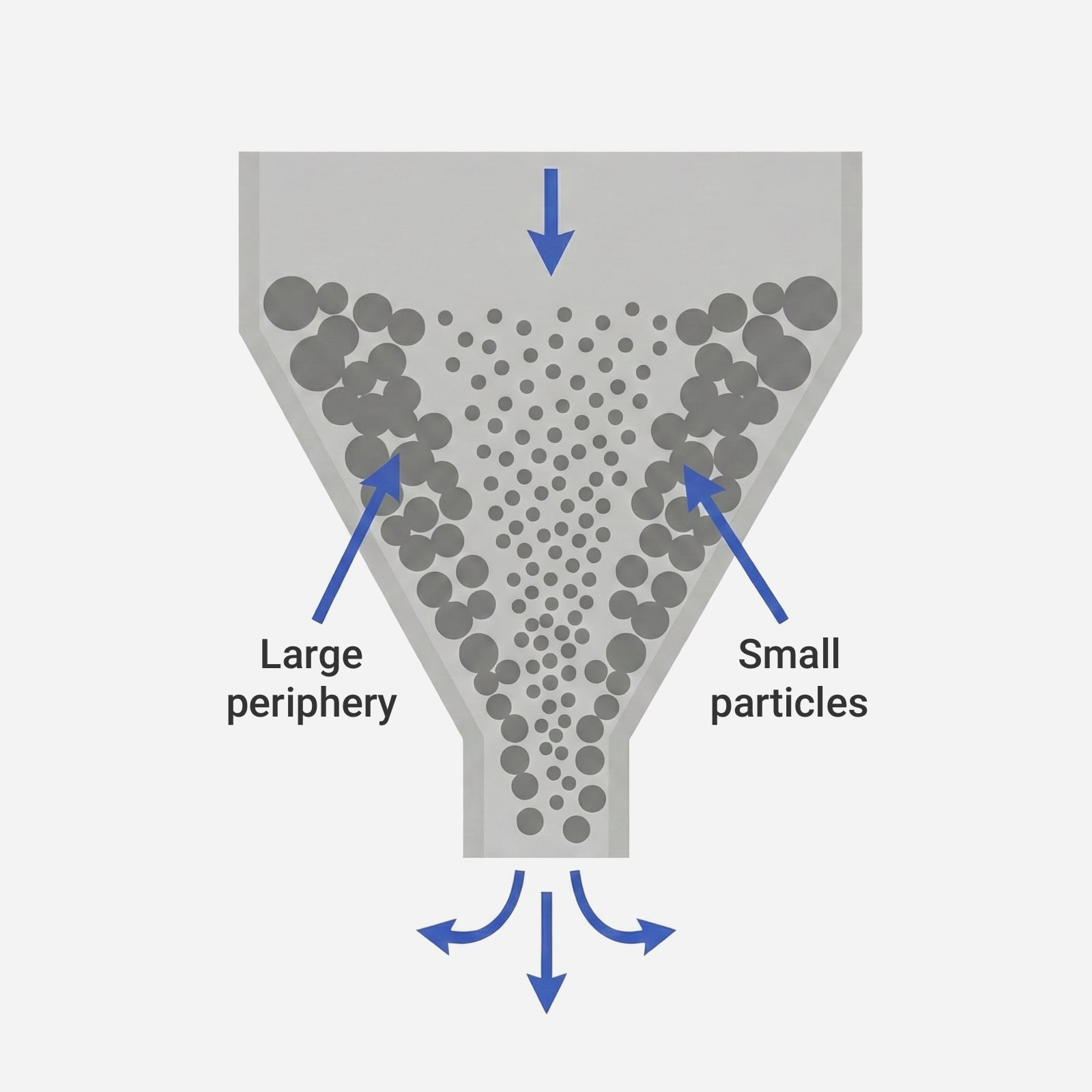
What it is
A blend separates into different components during handling - fines settle, coarse particles migrate to edges, and composition shifts from start to end of discharge.
What it looks like
- Early and late discharge have different compositions
- Tablet content uniformity or flavour/nutrient variation issues
- Problems worsen after vibration, transport, or surging events
Investigate with
- Powder Flow Speed Dependence (PFSD) – Identifies speed sensitivity and flow instability that cause surging and erratic discharge — two of the primary drivers of segregation in handling.
- Cohesion (1 speed) – Detects the cohesive behaviour and ratholing tendency that can cause sudden collapse events, redistributing blend components unpredictably.
Segregation itself is best quantified with a dedicated segregation test or particle size analysis – but reducing the flow conditions that drive it is where the PFA directly helps.
Your Texture Analyser can also investigate this
Remove the PFA and your instrument measures the mechanical side of the same problem.
Differences in particle or agglomerate strength between blend components can influence breakage and fines generation, indirectly promoting segregation. Texture analysis helps characterise strength differences that may lead to selective degradation during handling.
Technical explanation
Segregation during handling can lead to non-uniform blends, inconsistent product performance, and quality failures. Even powders that appear homogeneous at rest may separate when subjected to movement, vibration, or changes in speed. Quantifying speed-dependent flow and compaction behaviour helps identify segregation risk and improve blend stability.
Why it happens
Differences in particle size, density, shape cause:
- sifting (fines percolate down),
- rolling segregation (coarse roll to edges),
- air effects (fines float).
Feeding and filling problems (process performance)
Inconsistent output, dosing drift, or flow that won't start
Won't start flowing
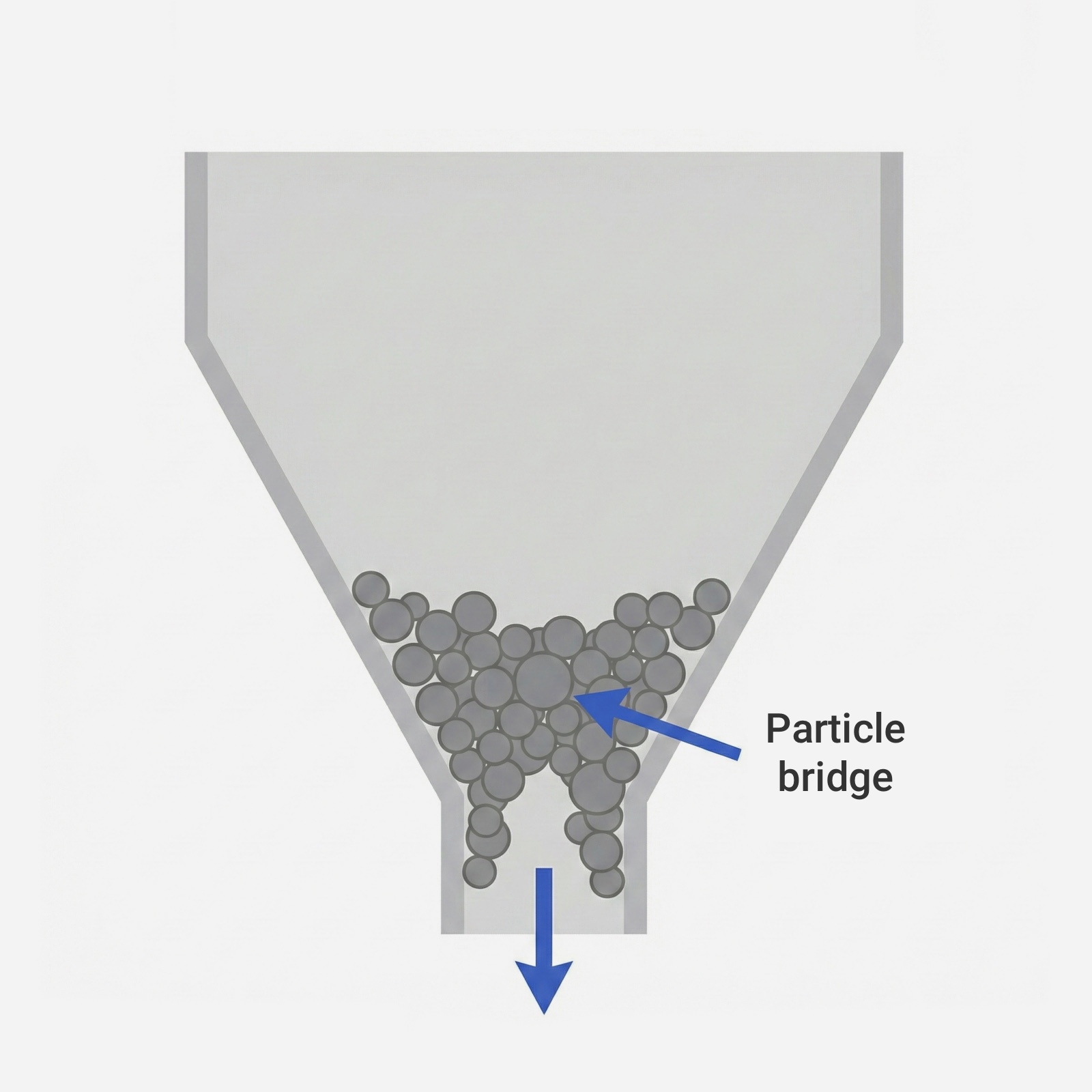
What it is
Powder runs acceptably during continuous operation but fails to start after a pause, changeover, or overnight hold - requiring manual intervention to restart.
What it looks like
- Continuous operation is fine, but pauses cause problems
- Fails after changeovers, weekend shutdowns, or overnight holds
- Requires tapping, vibrating, or manual intervention to restart
- Getting worse over time or in humid conditions
Investigate with
- Powder Consolidation and Caking - This directly replicates restart conditions and quantifies the energy required to re-initiate flow
- Caking - If cake strength / mean cake strength are trending high this indicates an increased risk of restart failure
- Cohesion (4 speeds)
- Compressibility - If Compressibility / relaxation are trending high this indicates the powder forms a more stable consolidated structure during rest, increasing resistance to flow initiation
Your Texture Analyser can also investigate this
Remove the PFA and your instrument measures the mechanical side of the same problem.
Texture analysis characterises the strength of consolidated powder beds formed during rest. Cake break and uniaxial compression tests measure the force or work required to initiate failure, directly supporting assessment of restart risk after pauses or storage.
Technical explanation
Why it happens
- Cohesion increases at rest due to moisture uptake, electrostatics, or time under load
- Consolidation creates a stable structure that resists movement
- A weak cake, arch, or bridge forms at the outlet or within the bed
Why it matters
When powders fail to start flowing after rest, production is disrupted by unplanned stoppages, manual intervention, and inconsistent feeding or filling. These issues often only appear after pauses or storage, making them difficult to detect with simple flow tests. Quantifying how powders consolidate and form weak cakes during rest helps predict restart risk, reduce downtime, and improve the reliability of feeding and filling operations.
Filling inconsistency/dosing drift

What it is
Fill weights vary run to run, change with line speed, or drift progressively over the course of a production run - even at constant settings.
What it looks like
- Same settings produce different fill weights at different times
- Fill weight changes when line speed is increased or decreased
- Output gradually runs in or drifts away over a production run
- Variability worsens after equipment changes or material lot changes
Investigate with
- Powder Flow Speed Dependence (PFSD) – A Speed Sensitivity Ratio above 1 indicates fill rate changes with speed; a Flow Stability value above 1 reveals drift or run-in behaviour.
- Cohesion (4 speeds) – Along with PFSD test this test helps separate low-speed vs high-speed behaviour.
- Compressibility
Your Texture Analyser can also investigate this
Remove the PFA and your instrument measures the mechanical side of the same problem.
Variability in filling performance can be influenced by powder bed stiffness and elastic recovery. Compression and relaxation measurements quantify how powders respond to repeated loading and unloading, helping explain drift in fill weight or dose over time.
Technical explanation
Inconsistent filling leads to variable pack weights, quality failures, regulatory risk, and increased product giveaway. Powders may pack differently depending on handling history, aeration, or stress, even when nominal bulk density appears acceptable. Measuring how powders condition and pack under repeatable conditions improves confidence in filling performance and material comparison.
Why it happens
- Powder is speed-sensitive (behaves differently at different flow rates).
- Powder changes during handling (breaks down or hardens).
- Air content varies.
Storage and handling problems
Changes during storage, transport, or repeated handling.
Caking/set-up

What it is
Powder forms lumps or a solid-like mass during storage or transport, requiring hammering or sieving before use, and making discharge from silos or drums unreliable.
What it looks like
- Hard lumps visible in bags, drums, or IBCs after storage
- Product needs breaking up before it can be used
- Poor restart from silos or hoppers after a storage period
- Problem worsens with longer storage times or in humid conditions
Investigate with
- Caking – Will indicate how much a cake forms and how strong it is
- Powder Consolidation and Caking – Will measure realistic "after load + time" strength.
- Compressibility – Will investigate whether it densifies strongly under stress.
Your Texture Analyser can also investigate this
Remove the PFA and your instrument measures the mechanical side of the same problem.
Texture analysis provides a direct measure of cake mechanical strength and breakability after storage. Cake break and penetration tests quantify how easily formed cakes can be fractured during handling, transport, or reprocessing.
Technical explanation
Caking reduces powder flowability, creates lumps, and makes discharge and reprocessing difficult. These problems often develop gradually and may not be evident during initial handling. Quantifying cake formation and strength under controlled conditions helps assess storage stability and reduce the risk of flow failure after transport or long-term storage.
Why it happens
- Consolidation under load.
- Moisture-driven bonding (humidity).
- Time-dependent particle bonding.
Compaction/consolidation sensitivity (not always “caking”)

What it is
Powder becomes noticeably denser after vibration, transport, or time under load - changing its flow behaviour even when no visible cake has formed.
What it looks like
- Bulk density changes significantly after transport or vibration
- Feeding behaviour is different after delivery vs in controlled conditions
- Hopper discharges well when full but poorly when partly empty
- Behaviour varies between the top and bottom of a large vessel
Investigate with
- Compressibility – The Compressibility profile is the best indicator
- Caking – Column height ratio (from caking) is another sign of strong consolidation.
Your Texture Analyser can also investigate this
Remove the PFA and your instrument measures the mechanical side of the same problem.
Uniaxial compression testing quantifies how powders gain strength under load and time, measuring yield behaviour, stiffness, and stress–strain response. This helps identify materials that rapidly consolidate into strong, flow-resistant structures even without forming a visible cake.
Technical explanation
Some powders are highly sensitive to applied stress and rapidly consolidate under load, changing their flow behaviour during storage or processing. This can lead to poor discharge, increased restart forces, or unexpected flow failure. Quantifying how powders compact, relax, and gain strength under stress helps predict handling performance and reduce problems caused by storage or process-induced consolidation.
Why it happens
- Particles rearrange and pack more efficiently under load, reducing void space and increasing contact points.
- Cohesive forces increase with contact area (e.g., van der Waals, capillary bridges with moisture), making the bed stronger.
- Time under stress allows creep/relaxation, so the powder bed gains strength while "resting."
- Fine particles and broad size distributions fill gaps more effectively, accelerating densification and strengthening.
- Moisture uptake or temperature changes can increase adhesion and promote consolidation during storage.
Attrition / breakdown / fines generation

What it is
Particles break or agglomerates crumble during conveying, mixing, or feeding - creating fines that progressively change flow behaviour, increase cohesion, or cause dusting.
What it looks like
- Powder becomes visibly dustier with repeated handling
- Flow behaviour changes during a run (gets easier or harder over time)
- Filters load faster than expected
- Product from later in a run differs from the start
Investigate with
- Powder Flow Speed Dependence (PFSD) – Flow Stability captures whether resistance changes from start to end (breakdown vs hardening). If Flow Stability shifts strongly, it’s a clue the material is changing during the test.
- Cohesion (1 speed)
Your Texture Analyser can also investigate this
Remove the PFA and your instrument measures the mechanical side of the same problem.
Texture analysis can assess the mechanical robustness of particles and agglomerates using compression and penetration tests. Weaker structures are more prone to fracture during handling, helping explain fines generation and changes in powder behaviour over time.
Technical explanation
Attrition occurs when particles break down during conveying, mixing, or feeding, generating fines that alter flow behaviour and product performance. Over time, this can increase cohesion, segregation, dusting, or caking, leading to gradual process degradation. Understanding how powders respond to dynamic handling conditions helps identify attrition risk and supports the selection of appropriate process parameters.
Why it happens
- Mechanical stresses during conveying, mixing, and feeding fracture weak particles or break fragile agglomerates.
- Impact and abrasion against equipment surfaces (bends, valves, feeders, screws) generate fines over time.
- High velocities, pressure drops, and turbulence in pneumatic systems increase collision frequency and severity.
- Repeated recirculation or reuse cycles progressively change the particle size distribution.
- Generated fines increase surface area and cohesion, which can then trigger secondary issues such as dusting, segregation changes, poorer flow, or increased caking.
FAQs
How does the PFA compare with other powder testing instruments?
|
Failure mode insight |
PFA |
FT4 |
Ring Shear |
Brookfield PFT |
Angle of Repose |
|
Cohesive resistance |
✔✔ |
✔ |
✔ |
✔ |
◐ |
|
Arching / bridging tendency |
✔✔ |
◐ |
✔ |
◐ |
✖ |
|
Ratholing risk |
✔ |
◐ |
✔✔ |
✔ |
✖ |
|
Flooding / flushing |
✔ |
◐ |
✖ |
✖ |
✖ |
|
Structural collapse behaviour |
✔✔ |
◐ |
✔ |
✖ |
✖ |
|
Clear separation of failure mechanisms |
✔✔ |
◐ |
◐ |
✖ |
✖ |


