


Consolidation and caking
Measuring how powders strengthen under load during storage – and predicting restart failure.

What is powder consolidation and caking?
When a powder that flowed freely before a weekend shutdown won't discharge on Monday morning, the culprit is usually not cohesion or bridging – it's consolidation. Under the weight of the powder column above it, particles rearrange, bonds form, and what was a loose bulk solid gradually becomes a coherent, load-bearing structure. The longer the dwell, the stronger the structure.
The Powder Flow Analyser (PFA) Powder Consolidation and Caking test measures this directly: a conditioned powder is held under a defined load for a controlled dwell time, then mechanically disturbed to measure the work required to fracture the consolidated structure. The result is a direct indicator of post-storage restart difficulty – not initial flowability, not dynamic handling performance, but specifically the energy needed to get flow started again after rest.
|
Powder Consolidation and Caking testing answers the question: "After storage under load, how difficult is it to break the consolidated powder and restart flow?" Powder Consolidation and Caking answers a fundamentally different question from dynamic flow tests: Not "will it flow?", but "will it flow again after storage?" |
How the powder consolidation and caking test works
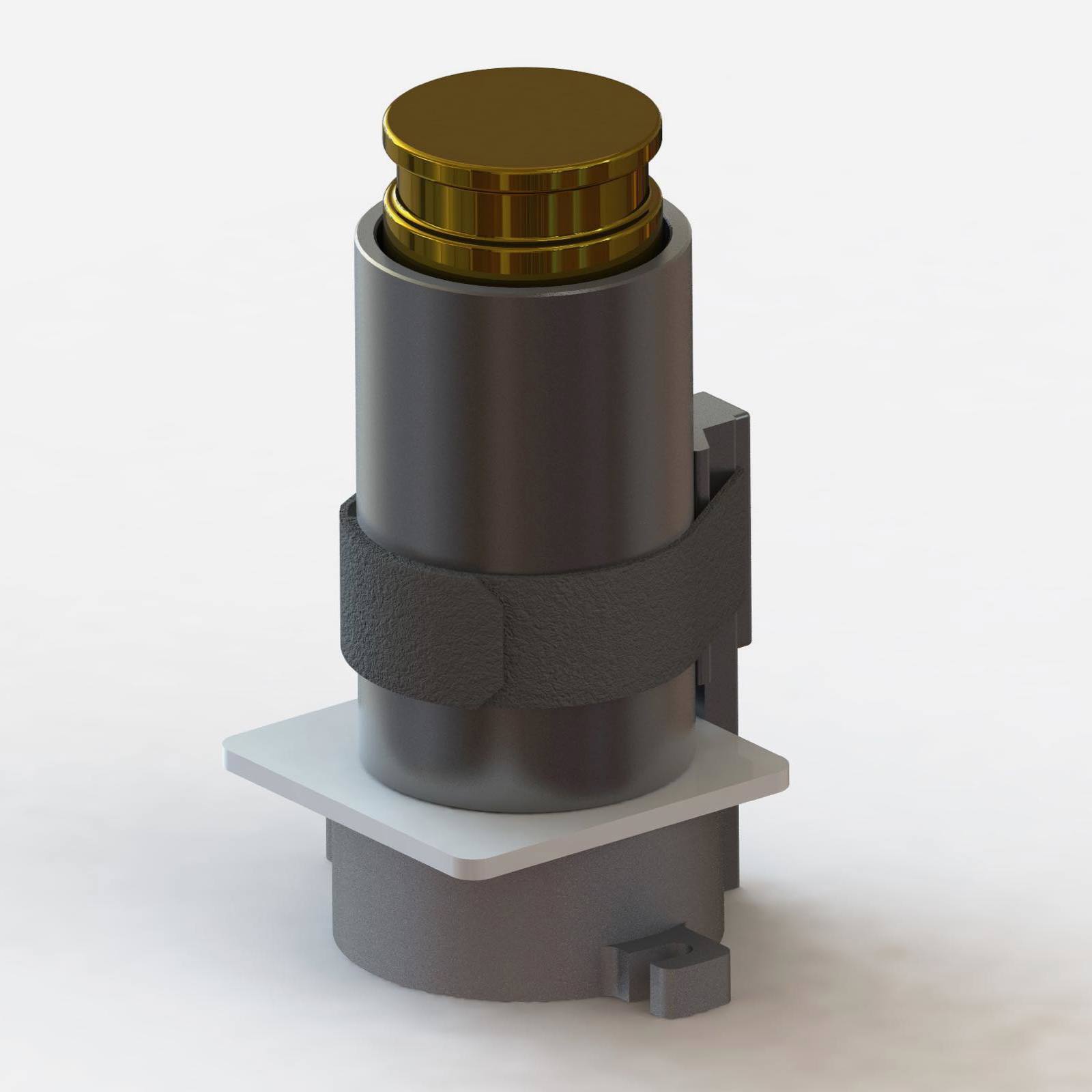 Weight applied to powder for dwell time
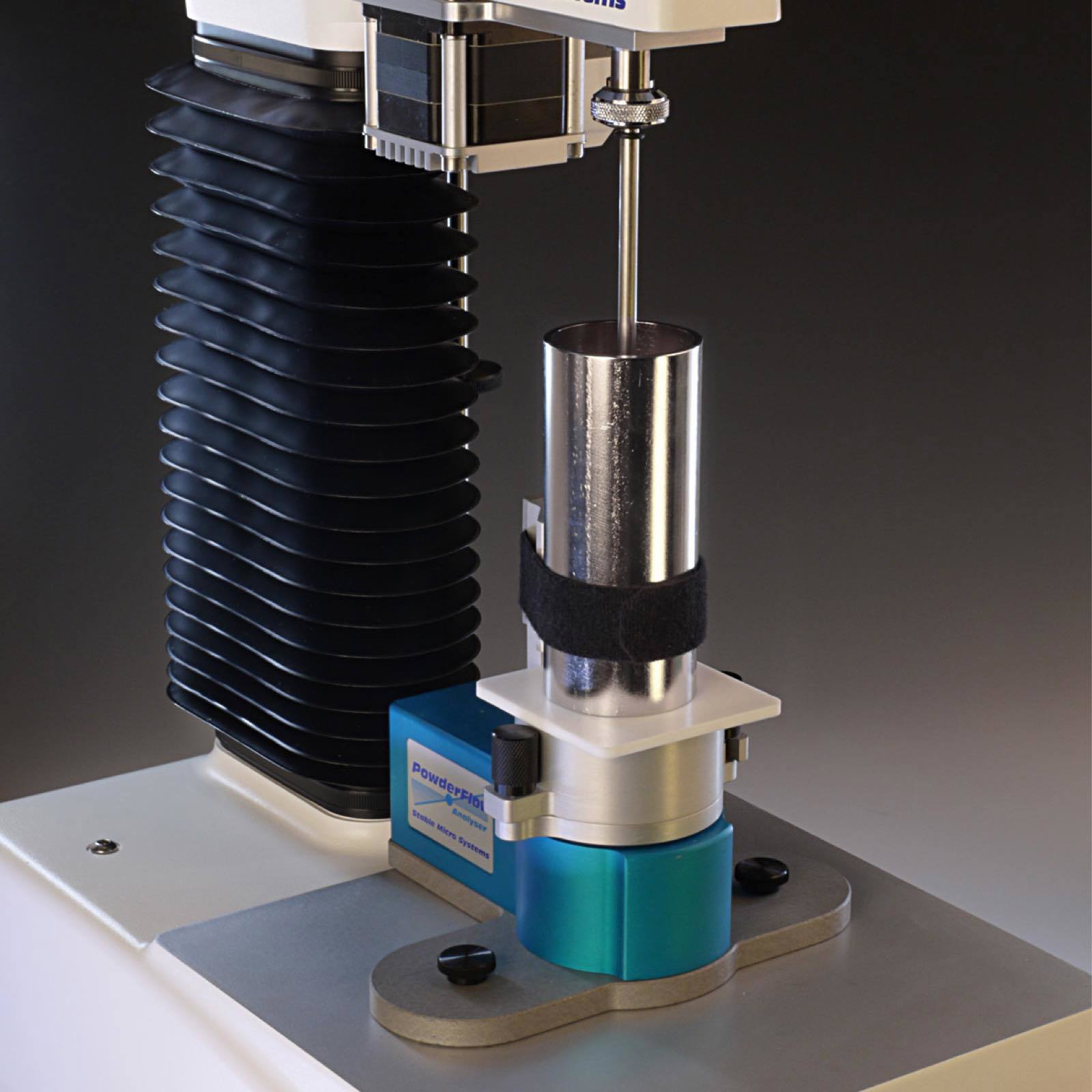 PFA blade then tests the consolidated cake
A conditioned powder bed is subjected to a defined normal load (using a weight) for a controlled dwell time, simulating storage under self-weight or external stress. During this period, the powder is allowed to consolidate naturally under the applied conditions.
After the dwell period, the load is removed and the powder bed is mechanically disturbed using a 40mm diameter PFA blade, measuring the work required to fracture the consolidated structure and restore movement. This work is calculated from the force–distance response during the break-up phase of the test.
The result directly reflects post-storage restart behaviour, rather than initial flowability or dynamic handling performance.

Measured parameters
- Work to Break Cake (g.s) – total energy required to fracture the consolidated powder bed
- Conditioned Bulk Density (g/ml) – bulk density after controlled preparation (split vessel)
Interpretation of the graph profile

During the break-up phase, a weakly consolidated powder will fracture easily, producing a low, smooth work response. A strongly consolidated powder will resist fracture, requiring substantial sustained work to break the structure.
The shape and magnitude of the response provide insight into whether the powder:
- forms a weak, fragile set-up, or
- develops a strong, persistent structure that resists restart
This behaviour is often not apparent from cohesion or flow tests performed without a dwell period.
Understanding the measured parameters
Work to Break – what it means
Energy required to fracture a powder bed after a defined load and rest period – direct indicator of post-storage restart risk.
|
Work to break behaviour |
What it indicates |
Likely implications in processing |
|
Low |
Weak consolidation; structure fractures easily |
Reliable restart after storage; minimal risk of flow failure |
|
Moderate |
Noticeable strength develops during storage |
Intermittent restart issues; may require agitation or vibration |
|
High |
Strong consolidated structure |
High risk of "won’t start" behaviour; poor silo or hopper emptying; manual intervention likely |
This parameter is a direct indicator of post-storage restart risk.
Bulk Density – what it means
What this parameter answers
"What density does the powder adopt after controlled, repeatable preparation?"
Bulk density reflects how particles arrange and pack under their own weight and gentle conditioning, not how they flow or fail.
|
Bulk Density behaviour |
What it indicates |
Likely implications in processing |
|
Low |
Inefficient packing; high voidage |
Larger pack volumes; higher fill variability if packing changes |
|
Moderate, consistent |
Repeatable packing under controlled preparation |
Reliable filling and QC trending |
|
High |
Efficient packing with little void space |
Smaller packs possible; increased consolidation sensitivity may occur |
|
Variable between samples |
Handling-sensitive packing behaviour |
Density drift, feeder instability, batch-to-batch variation |
When is a powder consolidation and caking test most useful?
Powder Consolidation and Caking testing is most useful when powders flow well initially but fail to restart after storage, shutdown, or extended dwell under load. The test directly measures how strongly a powder sets up after being stored under a defined load and how much energy is required to break that consolidated structure. It is particularly relevant for silo discharge, hopper restart, and "won’t start" complaints following storage.
What this test measures (and why it’s different)
Unlike dynamic flow tests, Powder Consolidation and Caking:
- explicitly includes time under load
- captures structure formation during rest
- focuses on restart and recovery, not steady-state flow
This makes it particularly valuable for diagnosing:
- "won’t start" complaints after shutdown
- poor emptying of hoppers or bins after storage
- unexpected lumps or solidified zones after transport
Linking consolidation and caking to other tests
Interpreting Powder Consolidation and Caking alongside other parameters helps distinguish why restart problems occur:
High work-to-break + high CI or Bridging Factor
- Cohesive or structure-driven powders that lock up after storage
High work-to-break + low CI
- Consolidation or packing-driven behaviour (often moisture or stress related)
- Investigate Compressibility and environmental sensitivity
Moderate work-to-break + low Column Height Ratio (from caking tests)
- Packing and settling dominate rather than classic hard caking
What to test next based on your Consolidation and Caking results
This test identifies whether storage-induced structural changes are likely to cause processing problems. The most useful follow-up tests depend on whether failure is driven primarily by consolidation, cake strength, or flow resistance after rest.
Low consolidation and low cake strength
High consolidation with weak caking
Typical behaviour:
Powder packs readily but does not form strong, persistent cakes.
Likely risks:
-
Fill mass variation
-
Increased restart resistance
-
Sensitivity to vibration or handling
Recommended next tests:
-
Compressibility – to quantify packing sensitivity
-
Cohesion – to assess flow resistance once motion begins
High consolidation with strong caking
Typical behaviour:
Powder densifies and forms mechanically strong structures during storage.
Likely risks:
-
Hopper blockage
-
Manual intervention required
-
Severe restart and discharge failures
Recommended next tests:
-
Cohesion – to determine resistance during flow after rest
-
Compressibility – to understand why the powder consolidates so readily under load
In these cases, storage-induced failure is often the dominant mechanism.
Why follow-up testing matters
Consolidation and Caking testing explains what happens during storage. Follow-up tests explain what happens when flow is required again. Together, they allow targeted mitigation strategies.
Sample data and its interpretation


Tabulated data and its meaning
|
Sample |
Caking Strength (g.s) |
What this indicates |
|
1 day consolidation |
330.5 |
Moderate set-up after short storage |
|
1 day consolidation with anti-caking agent |
119.5 |
Significantly reduced cake strength |
|
4 day consolidation |
665.0 |
Strong consolidation and cake formation |
|
4 day consolidation with anti-caking agent |
206.4 |
Set-up still increases with time, but remains much weaker |
Interpreting the results by condition
1 day consolidation – moderate restart risk
What the number says
A caking strength of 330.5 g·s indicates that the powder develops a measurable but breakable structure after one day under load.
Expected behaviour in practice
- Powder may restart with some resistance after short storage.
- Minor lumping or partial bridging may occur.
- Flow can usually be recovered with normal start-up forces.
This is typical of powders that are acceptable in continuous operation but show early signs of time-dependent set-up.
1 day consolidation with anti-caking agent – improved storage robustness
What the number says
The caking strength drops to 119.5 g·s, representing a ~65% reduction in work required to break the consolidated structure.
Expected behaviour in practice
- Much easier restart after short storage.
- Reduced lump formation.
- Lower risk of flow complaints after overnight or weekend stops.
What this tells us
The anti-caking agent is effective at disrupting inter-particle bonding early, reducing the development of a coherent structure during short-term storage.
4 day consolidation – high restart and discharge risk
What the number says
A caking strength of 665.0 g·s indicates the formation of a strong, persistent consolidated structure after extended storage.
Expected behaviour in practice
- High risk of “won’t start” behaviour.
- Strong, stable lumps or solidified zones.
- Manual intervention, vibration, or mechanical agitation likely required.
- Poor emptying of hoppers, bins, or packs after storage.
This is a classic example of time-dependent consolidation dominating behaviour, even if the powder flows acceptably during continuous operation.
4 day consolidation with anti-caking agent – reduced but not eliminated risk
What the number says
The caking strength is reduced to 206.4 g·s, a substantial improvement compared to untreated material, but still significantly higher than the 1-day condition.
Expected behaviour in practice
- Restart after long storage is much more achievable, but not risk-free.
- Some resistance or partial set-up may still occur.
- Performance will depend on applied start-up stress and equipment design.
What this tells us
The anti-caking agent slows and limits consolidation, but does not completely prevent time-dependent structure formation under load.
Time dependence: the key insight from this test
This dataset clearly shows that:
- Caking strength increases strongly with consolidation time
- Anti-caking agents:
- significantly reduce cake strength
- but do not fully remove time dependence
This is precisely the behaviour that dynamic flow tests cannot capture.
How this links to other powder tests
- High caking strength + time dependence
- Confirms consolidation-driven restart risk
- Cross-check with Compressibility for packing sensitivity
- If Cohesion Index is moderate or low
- Flow problems are not "stickiness-driven"
- Storage and load history are the dominant factors
- Anti-caking reduces caking strength but not time sensitivity
- Environmental control, storage time, and load still matter
Test guidance
- Powder Consolidation and Caking is not a flowability test; it evaluates restart after rest.
- A powder may flow well dynamically and still fail catastrophically after storage.
- Results are highly sensitive to:
- applied load
- dwell time
- environmental conditions
These should always reflect realistic process scenarios.
This test should be interpreted alongside:
- Cohesion/Bridging Factor (flow initiation and failure mode)
- Compressibility (packing and densification sensitivity)
- Caking (cycling) when cake fraction and strength distribution are also important
How Powder Consolidation and Caking should be used (decision guidance)
Most useful when:
- Investigating “won’t start” behaviour after shutdown
- Assessing silo, hopper, or bin emptying after storage
- Evaluating the effect of storage time or load on flow recovery
- Comparing formulations for storage robustness
Should NOT be used alone when:
- Diagnosing high-speed handling or throughput issues → use PFSD
- Investigating arching or ratholing without a storage component → use Cohesion / Bridging Factor
- Assessing cake fraction or distribution → use Caking (cycling)
- Measuring mechanical strength of formed products → use texture analysis strength tests
How the Consolidation and Caking test compares with other powder flow tests
Consolidation and Caking vs Compressibility
- Compressibility measures packing under load.
- Consolidation and Caking assesses whether that packing leads to strength development.
Why this matters:
Not all compressible powders cake. This test determines whether consolidation results in mechanically stable structures.
Consolidation and Caking vs Caking (standalone)
- Standalone caking focuses on cake strength.
- Consolidation and Caking explicitly links applied stress, consolidation, and strength.
Why this matters:
This test provides greater insight when storage loads vary or when failure depends on both stress and time.
Consolidation and Caking vs Cohesion
- Consolidation and Caking focuses on storage-induced changes.
- Cohesion focuses on resistance during movement.
Why this matters:
A powder may store poorly but flow acceptably once motion begins - or vice versa. Both behaviours must be understood to diagnose real processing problems.
FAQs
What does the Powder Consolidation and Caking test measure?
This test measures how a powder densifies under load (consolidation) and whether that consolidated structure develops mechanical strength over time (caking). It captures both structural formation and structural strengthening.
How is this different from a caking test alone?
A caking test focuses primarily on strength development after consolidation. The Powder Consolidation and Caking test explicitly links applied stress, resulting consolidation, and subsequent cake strength, providing a more complete picture of storage behaviour.
Is this the same as compressibility testing?
No. Compressibility measures how a powder packs under load but does not assess whether that packed structure becomes mechanically strong. Consolidation and Caking testing bridges the gap between packing behaviour and storage-induced failure.
Why is this important for storage and transport?
During storage, powders experience load from their own weight, stacked containers, or vibration. Consolidation and Caking testing helps predict whether these conditions will lead to hard-set cakes, discharge failure, or difficult restart.
Is this test suitable for quality control?
Yes, particularly when powders must remain flowable after defined storage or transport conditions, or when supplier or formulation changes may affect storage stability.


