


Caking
Measuring how much of the powder bed becomes a cake, how strong it is, and what that means for storage, restart and discharge.

What is powder caking?
Caking is what happens when a powder that flowed freely when filled into a hopper, bin, or bag no longer does so after it has sat under its own weight for hours, days, or weeks. Particles bond together under applied stress – driven by moisture, temperature cycling, particle surface chemistry, or simply consolidation pressure – and form a structured mass that resists discharge, clogs outlets, and can require manual intervention to break up.
The Powder Flow Analyser (PFA) Caking test measures this directly: a powder column is subjected to repeated controlled compaction cycles, and the test records how much of the bed transforms into a cake and how strong that cake is. The result is a multi-parameter picture of storage stability – not a single "pass/fail" – which is why the parameters need to be read together rather than in isolation.
|
Caking testing answers the question: "After compaction cycles, how much of the bed becomes a cake and how strong is that cake?" |
How the caking test works
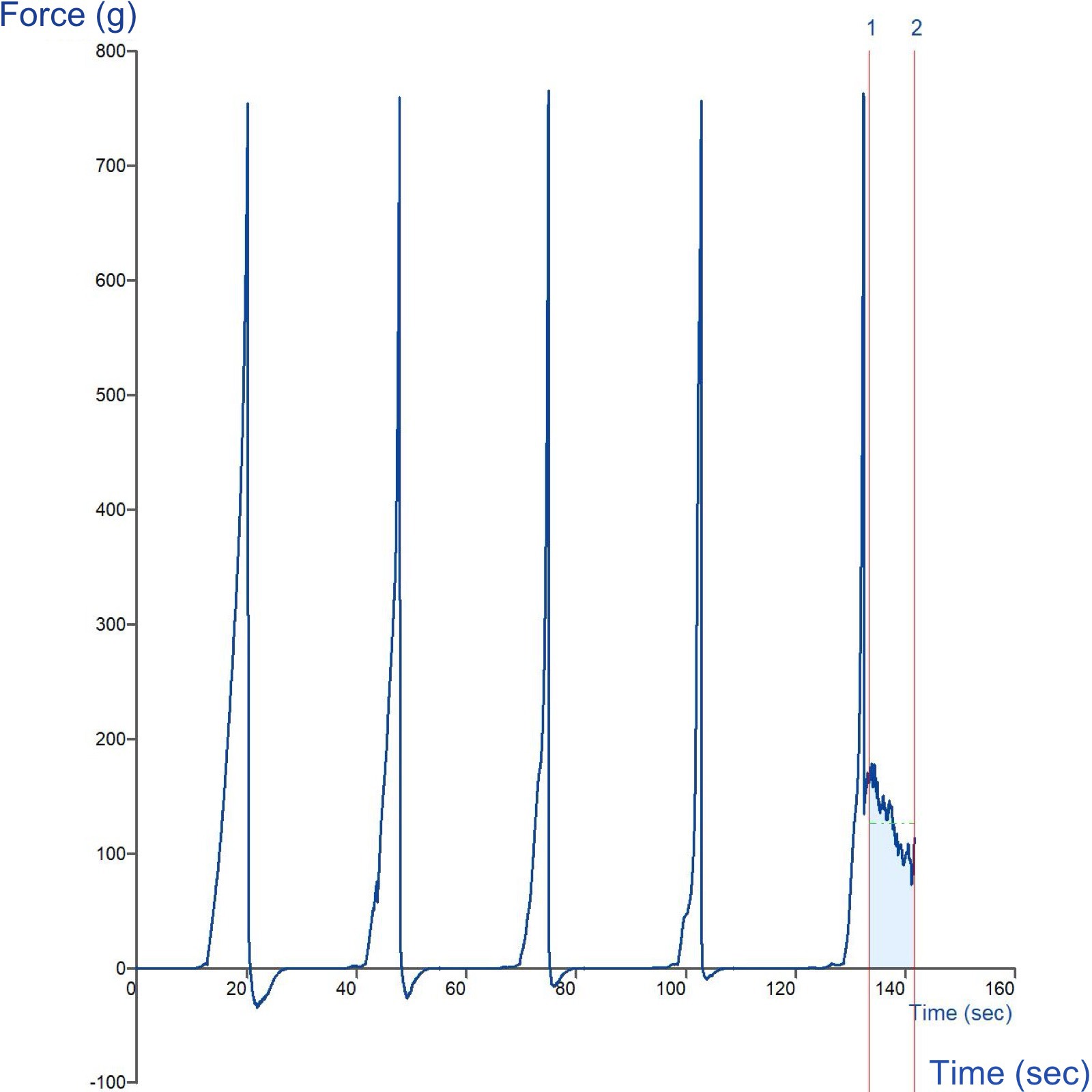
The test begins with 2 conditioning cycles to remove any user loading variation and to normalise the powder column after filling. The blade levels the top of the powder column and measures its height. The blade then moves down through the column and compacts the powder to a pre-defined force (usually 750g). When it reaches this force it measures the height of the cake and slices up through the powder with minimum disturbance. This compaction cycle is repeated four more times. The 5th time the target force is reached the blade slices through the compacted cake of powder formed at the bottom of the vessel.
Measured parameters
- Cake Height Ratios (e.g. Ratio 5) – how much of the bed behaves like a cake
- Column Height Ratios – how much the bed consolidated/settled during compaction cycling
- Mean Cake Strength (g) – how hard the cake is to break measured as the average force to cut the cake
- Cake Strength (g.mm) – the total work required to break the cake
- Conditioned Bulk Density (g/ml) – bulk density after controlled preparation (split vessel)
Interpretation of the graph profile

The column height ratio (current cycle column height divided by initial column height) and the cake height ratio (current cycle cake height divided by initial column height) are recorded to give information about the settlement and compaction of the powder column.
A powder that has a high tendency to cake would show a large decrease in column height ratio and a strong increase in cake height ratio.
Once the cake has been formed at the end of the fifth cycle the blade cuts through the cake and measures the force required to do so. This force is recorded as the cake strength and is the work required to cut the cake (g.mm) and the mean cake strength is the average force to cut the cake in grams.
Mean cake strength is a useful measurement as it removes the influence of cake height from the calculation.
Understanding the measured parameters
Cake Height Ratio (Cake Fraction) – what it means
Proportion of the powder bed forming a cake after compaction
What this parameter answers:
"How much of the powder bed behaves like a cake after compaction?"
|
Cake Height Ratio |
What it indicates |
Likely implications in processing |
|
< ~0.3 |
Only a small portion of the bed forms a cake; most material remains loose. |
Low risk of large, persistent lumps after storage. Discharge problems are more likely driven by geometry or cohesion, not bulk set-up. |
|
~0.3 – 0.7 |
A significant portion of the bed consolidates into a structured zone. |
Partial set-up after storage; inconsistent discharge; lump formation possible, especially after vibration or transport. |
|
> ~0.7 |
Most of the bed behaves as a cake. |
High likelihood of large lumps, poor restart, and incomplete discharge from hoppers, bins, or packs after storage. |
Column Height Ratio – what it means
Degree of bed consolidation and settling during compaction cycling.
What this parameter answers:
"How much does the powder bed collapse and densify during compaction?"
|
Column Height Ratio |
What it indicates |
Likely implications in processing |
|
≈ 1.0 |
Little change in bed height; limited consolidation. |
Bulk density remains relatively stable during storage or transport. Fill and feeder behaviour are more predictable. |
|
Moderately < 1.0 |
Noticeable settling and densification. |
Bulk density drift; changes in feeder performance; fill weight variation after transport or vibration. |
|
Strongly < 1.0 |
Severe consolidation and packing sensitivity. |
High risk of density drift, poor restart, and process instability even without a strong “cake.” |
Mean Cake Strength – what it means
Average resistance of formed cakes to fracture.
What this parameter answers:
"How hard is the cake that forms?"
|
Mean Cake Strength |
What it indicates |
Likely implications in processing |
|
Low |
Cakes break easily under modest force. |
Weak set-up; lumps may form but break down readily during handling or discharge. Restart is usually manageable. |
|
Moderate |
Cakes require noticeable force to break. |
Stable lumps after storage; discharge issues likely unless sufficient stress is applied. Manual intervention may sometimes be required. |
|
High |
Cakes are mechanically strong and resistant to break-up. |
Severe storage and restart problems; persistent lumps; mechanical agitation or redesign often required. |
Key point: Cake fraction tells you how much cakes; cake strength tells you how serious it is.
Cake Strength – what it means
Total energy required to fully fracture the cake
What this parameter answers:
"How much total energy is required to fully break down the cake once it has formed?"
This captures both cake size and cake strength, making it especially relevant to restart, emptying, and reprocessing.
|
Cake Strength (work to break) |
What it indicates |
Likely implications in processing |
|
Low |
Cake breaks down easily with minimal applied work. Even if a cake forms, it is fragile. |
Lumps may appear after storage but break down readily during discharge, vibration, or handling. Restart is usually manageable. |
|
Moderate |
Cake requires sustained work to fully break down. |
Partial discharge, intermittent flow, or the need for agitation is likely after storage. Restart performance may be inconsistent. |
|
High |
Cake requires substantial work to fracture completely. The cake is persistent once formed. |
Severe restart problems, incomplete emptying of bins or packs, need for mechanical agitation or manual intervention. High risk of rework or downtime. |
Bulk Density – what it means
What this parameter answers:
"What density does the powder adopt after controlled, repeatable preparation?"
Bulk density reflects how particles arrange and pack under their own weight and gentle conditioning, not how they flow or fail.
|
Bulk Density behaviour |
What it indicates |
Likely implications in processing |
|
Low |
Inefficient packing; high voidage |
Larger pack volumes; higher fill variability if packing changes |
|
Moderate, consistent |
Repeatable packing under controlled preparation |
Reliable filling and QC trending |
|
High |
Efficient packing with little void space |
Smaller packs possible; increased consolidation sensitivity may occur |
|
Variable between samples |
Handling-sensitive packing behaviour |
Density drift, feeder instability, batch-to-batch variation |
Which caking parameter answers which question?
|
Caking parameter |
Core question it answers |
What it is most useful for |
|
Cake Height Ratio |
How much of the powder bed becomes a cake? |
Identifying the extent of set-up after storage or transport; predicting whether problems involve isolated lumps or large structured zones. |
|
Mean Cake Strength |
How hard is the cake locally? |
Assessing lump hardness and resistance to fracture; relevant to break-up during discharge, vibration, or downstream handling. |
|
Cake Strength (total work) |
How difficult is the cake to completely remove once formed? |
Predicting restart difficulty, incomplete emptying, need for agitation or manual intervention; critical for bins, silos, and rework. |
|
Column Height Ratio |
How much does the bed settle and densify during storage or compaction? |
Identifying packing and consolidation sensitivity, bulk density drift, and changes in feeder or fill performance even without a strong cake. |
|
Powder Consolidation and Caking (work-to-break after dwell) |
How does the powder behave after load and time at rest? |
Assessing flow failure after storage or shutdown, delayed discharge, and restart risk under self-weight or applied load. |
Note: No single parameter describes powder behaviour. Different caking parameters describe different aspects of set-up.
Caking behaviour is multi-dimensional. Some powders form large but weak cakes; others form small but extremely persistent ones. Interpreting caking parameters together allows realistic prediction of storage and restart performance.
When is a caking test most useful?
A caking test is most useful when powders form lumps, set up during transport, or fail to discharge cleanly after storage or vibration. It assesses how much of the powder bed becomes a cake under repeated compaction and how strong that cake is. This test is especially relevant for diagnosing storage, transport, and handling issues, as well as understanding how packing and consolidation during movement contribute to post-storage flow problems.
What to test next based on your caking results
The caking test identifies whether a powder is likely to strengthen during storage or rest. The most useful follow-up tests depend on how severe the caking is and how quickly it develops.
Low or negligible caking
Typical behaviour:
Powder retains its flowability after storage and rest.
Likely risks:
- Issues are more likely related to flow dynamics than storage.
Recommended next tests:
- Cohesion testing – to assess resistance to movement during flow
- PFSD – if behaviour varies with operating speed
Moderate caking
Typical behaviour:
Powder shows some strengthening during storage but may still break down under agitation.
Likely risks:
- Restart issues after pauses
- Increased energy required to re-establish flow
Recommended next tests:
- Cohesion – to understand resistance once motion begins
- Compressibility – to assess packing sensitivity
Severe or rapid caking
Typical behaviour:
Powder forms strong, self-supporting structures during storage.
Likely risks:
- Hopper blockage
- Manual intervention required
- High risk during transport or long-term storage
Recommended next tests:
- Compressibility – to quantify consolidation sensitivity
- Cohesion – to determine whether flow resistance compounds restart problems
In these cases, caking behaviour is often the dominant failure mechanism.
When caking testing is essential
Caking testing is particularly valuable when:
- Powders are stored or transported for extended periods
- Restart after shutdown is problematic
- Seasonal or humidity-related failures occur
- Formulation or supplier changes affect storage behaviour
Why follow-up testing matters
Caking results explain what happens during rest. Follow-up tests explain what happens next – during restart, discharge, or handling. Together, they allow more targeted mitigation strategies.
Sample videos
Sample caking test data and its interpretation


Tabulated data and its meaning
|
Sample |
Caking test data (key metrics) |
Key message & likely processing issues |
Cross-reference testing |
|
Wallpaper adhesive |
Mean Cake Strength 548.07 |
Huge cake + very strong. Extremely high risk of hard set-up after storage or transport; persistent lumps; poor restart; likely need for mechanical agitation or manual intervention. |
Explains severe issues seen in Cohesion (very high Bridging Factor) and PFSD. Classic high-risk storage material. |
|
Flaked rice |
Mean Cake Strength 220.86 |
Large cake, strong. Forms stable lumps after storage or vibration despite appearing granular; discharge problems after rest. |
Often driven by particle shape/interlocking. Cross-check Cohesion (Bridging Factor) rather than CI alone. |
|
Face powder |
Mean Cake Strength 162.45 |
Severe consolidation / settling. Significant densification during storage or transport; bulk density drift; feeder and refill performance changes; restart sensitivity even without a large hard cake. |
Matches very high CI in cohesion testing. Cross-check Compressibility to quantify packing and elastic recovery behaviour. |
|
Coarse sea salt |
Mean Cake Strength 145.97 |
Large cake fraction, moderate strength. Structured zones form readily during storage; discharge problems if outlet geometry is marginal. |
Combined with very high Bridging Factor, explains restart failures. Cross-check Cohesion and PFSD. |
|
Table salt |
Mean Cake Strength 9.06 |
Weak caking. Low risk of hard set-up under tested conditions; generally good restart behaviour after storage. |
Useful “good storage” reference. If issues arise, investigate geometry or moisture, not caking strength. |
|
Water softener |
Mean Cake Strength 7.68 |
Weak caking. Minimal storage-related flow failure; generally robust against consolidation under load. |
Cross-check Bulk Density or Compressibility if pack settling or fill variation is reported. |
Charts
 Caking scatter: Combines cake fraction and cake strength to visualise storage set-up risk and restart difficulty.
 Comparison of mean cake strength for a range of samples
How Cake Strength differs from Mean Cake Strength (important distinction)
Mean Cake Strength
How hard the cake is locally (resistance per unit fracture event)
Cake Strength (total work)
How much overall effort is required to destroy the entire cake
Why both matter
- A small but very hard cake may have high mean strength but moderate total work
- A large, moderately strong cake may have very high total work and be harder to clear in practice
This distinction explains why operators often report: “It’s not that the cake is rock-hard – it’s that there’s so much of it.”
 Powder cake height ratio trend for a range of samples
 Powder column height ratio trend for a range of samples
Understanding Cake Height Ratio vs Column Height Ratio
In the caking test, Cake Height Ratio and Column Height Ratio describe two related but fundamentally different behaviours.
Cake Height Ratio indicates how much of the powder bed has transformed into a coherent cake after compaction cycles – in other words, the extent of caking. A high value means a large fraction of the bed behaves as a single, structured mass.
In contrast, Column Height Ratio describes how much the entire powder bed has settled and densified during the test, regardless of whether a strong cake has formed. A low Column Height Ratio highlights packing and consolidation sensitivity, which can lead to bulk density changes, feeder instability, and restart issues even when cake strength is modest.
Interpreting these parameters together allows users to distinguish between problems driven by cake formation and those driven by bed consolidation and settling.
How the caking test compares with other powder flow measurements
Caking vs Cohesion
- Caking measures strength development during storage or rest.
- Cohesion measures resistance to movement during flow.
- A powder may show low cohesion initially but severe caking after storage - leading to restart failures.
Caking vs Compressibility
- Compressibility measures how a powder packs under load.
- Caking measures whether that packed structure becomes mechanically strong.
- High compressibility often increases the risk of caking but does not guarantee it.
Caking vs PFSD
- PFSD focuses on speed-dependent flow behaviour.
- Caking focuses on time-dependent strength development.
- Together, they help distinguish between dynamic flow problems and storage-induced failures.
Additional tests
Caking strength can be a highly desirable property of a finished product and can be assessed easily using the Texture Analyser.
FAQs
What does the caking test actually measure?
The caking test measures a powder’s tendency to consolidate and strengthen over time when subjected to load. It simulates storage conditions where powders experience pressure from their own weight or from stacked containers.
Is caking the same as cohesion?
No. Cohesion describes resistance to movement during flow, while caking describes time-dependent strength development during storage or rest. A powder can be free-flowing initially but still exhibit severe caking after storage.
Does visible caking always mean flow problems?
Not always. Some powders cake during storage but break down easily once disturbed. The caking test helps determine whether the strength developed during storage is likely to cause restart, discharge, or handling issues.
How long should a caking test be run?
The appropriate consolidation time depends on the application. Short consolidation times may simulate brief process stoppages, while longer times represent storage or transport. Comparative testing under consistent conditions is often more informative than absolute values.
Is the caking test suitable for quality control?
Yes. Caking tests are well suited to QC applications where powders must remain free-flowing after defined storage periods or transport conditions.


