

How the Powder Flow Analyser works
From flow to compaction – one instrument does it all.
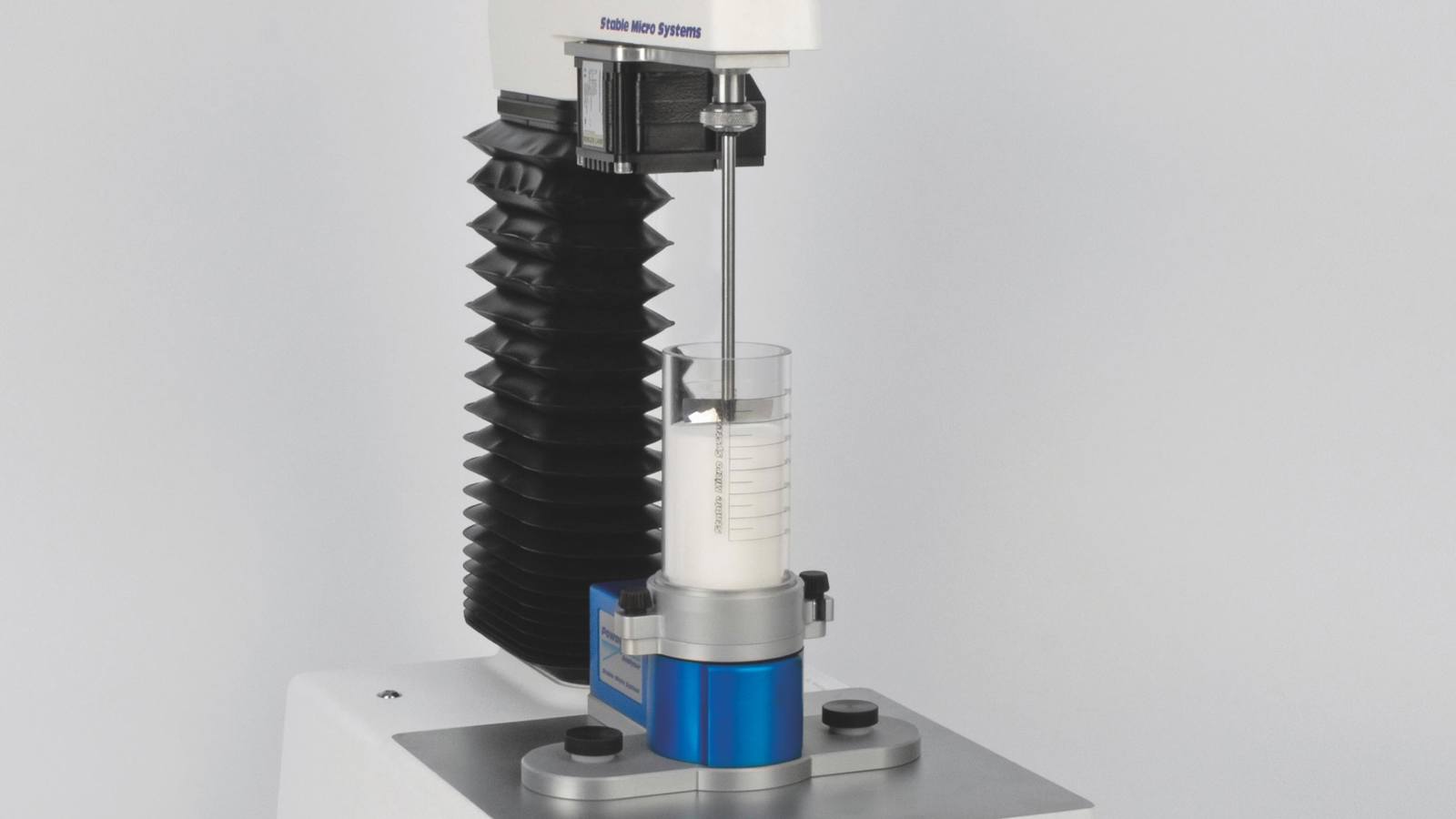
The Powder Flow Analyser (PFA) extends the capabilities of the TA.XTplusC Texture Analyser into powder flow testing. It uses a precision helical blade to move through a column of powder under controlled conditions while measuring axial force, time and distance. Exponent Connect software then analyses this data to quantify how the powder behaves.
This page explains how a typical test works, how the blade moves the powder, and why the engineering of the rotor is so important for reliable powder flow measurement.
At a glance
| The Powder Flow Analyser does not give a single number – it provides a complete powder behaviour fingerprint. |
The Powder Flow Analyser:
- Is an accessory mounted on a TA.XTplusC Texture Analyser
- Uses a precision helical blade to displace powder in a controlled, repeatable way
- Measures axial force, time and distance during each test
- Allows Controlled Flow actions: lifting/aerating, compacting/compressing, slicing/shearing and mixing
- Fully programmable via Exponent Connect software with library methods, calibration, verification and custom projects
A typical powder flow analysis test
A typical powder flow test consists of the following stages:
Choose your test
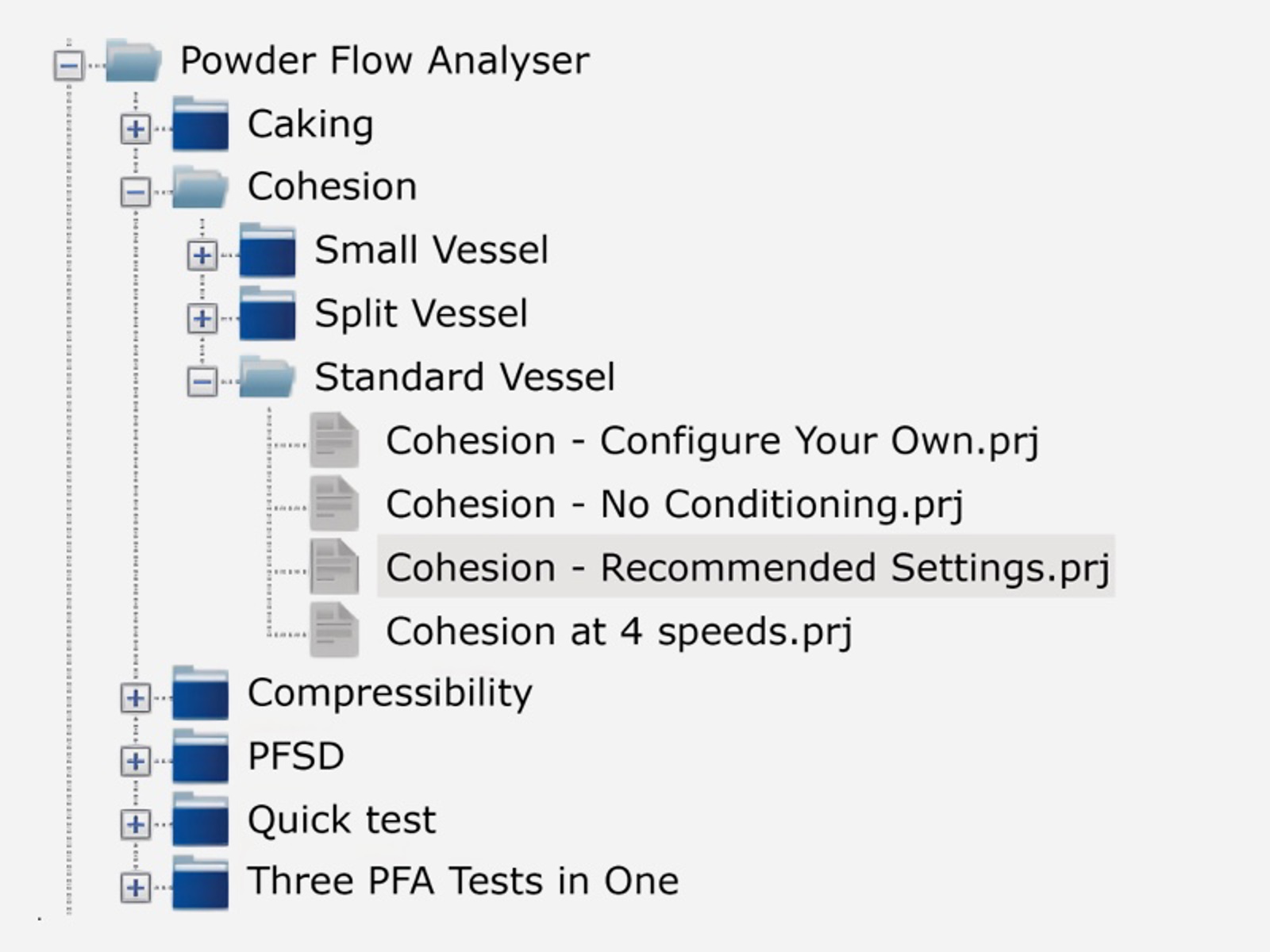
Select a recommended test
The Powder Flow Analyser is supplied with library tests so operators can start testing quickly and conveniently after straightforward installation and calibration.
or
Configure your own test
Users can fully program the instrument and each movement can be configured for path angle, direction and tip speed to impose lifting, compacting, slicing or mixing actions.This makes it possible to design test protocols that mimic real process conditions in hoppers, feeders, conveyors and packing lines.
Sample loading and conditioning
A known volume of powder is poured into a test vessel.
A conditioning sequence gently moves the blade through the powder column to eliminate variability introduced by the operator during sample loading, as well as any residual compaction from earlier tests. The only exception is when an intentionally consolidated sample is being assessed, in which case no conditioning is applied.
During the test
The software runs a programmed sequence of downward and upward blade movements.
Axial force, time and distance are measured by a sensitive transducer and the data is displayed and analysed in real time by Exponent Connect software.
Post-test analysis
Exponent Connect displays force-time and force-displacement curves in real time.
At the end of the test, the software calculates key powder flow parameters using pre-configured analysis macros. Sample results can be ranked and compared to assess the impact of external conditions such as humidity and moisture content, surface properties, electrostatic charge and particle size, shape and distribution.
By repeating the same test sequence on different batches, formulations or supplier lots, you can quantify differences in powder behaviour instead of relying on subjective impressions alone.

What the Powder Flow Analyser measures
During a test, the Powder Flow Analyser captures axial force over time and position. Exponent Connect then uses this data to calculate parameters that relate to:
- Cohesion – how strongly particles stick together and resist movement
- Caking – how powders consolidate and form solid masses under stress or over time
- Flow stability – how consistent the flow behaviour is from the start to the end of a test
- Flow speed dependence – how sensitive the powder is to changes in blade (and therefore process) speed
- Compressibility and relaxation – how packing density changes under load and then relaxes when the load is removed
Depending on the test type, the software can also report specific indices and coefficients designed to make it easy to compare materials and batches.
Controlled flow displacement
 Rotational and directional effects of blade movement
The Powder Flow Analyser’s helical blade can be programmed to move in different ways through the powder column. By changing the direction of travel, helix path and speed, you can emphasise different aspects of powder behaviour.
Slicing and shearing
The blade moves through the powder while following its exact helical path.
This creates a largely cutting or shearing action rather than pushing a solid plug of powder ahead of the blade.
It allows the rotor to pass down through the column with minimal disturbance when needed, or to slice upwards through a compacted cake to investigate its resistance.
Lifting and aerating
The blade moves upwards in an anti-clockwise direction, following its helical path and lifting the powder.
This gently loosens and aerates the sample, breaking weak structures and evening out packing density.
Lifting strokes are typically used to condition the powder before measurement, or to study how easily a powder re-flows after compaction or storage.
Compaction and compressing
The blade moves clockwise downwards and compacts the powder column to a defined force.
By repeating compaction steps, you can build up a compacted cake at the bottom of the vessel.
Subsequent movements then slice through this compacted layer to assess cake strength and how easily it breaks apart.
This mode is useful for investigating caking during storage, the impact of moisture or fat content, and the effect of vibration or pressure on powder stability.
Because these movements are fully programmable, you can design test sequences that imitate real handling conditions in hoppers, chutes, conveyors or filling systems.
Notes on sample preparation
Why powder sample preparation matters
Powders are surprisingly sensitive to how they’re handled. The same material can occupy very different volumes depending on what’s just happened to it. For example:
- Pouring powder out of a container introduces air and makes it appear “fluffier”
- Tapping or vibrating the container encourages the particles to settle and pack more tightly
In other words, the bulk density is constantly changing because the internal stress within the powder bed is changing.
The problem: changing stress, changing behaviour
When the stress state inside the powder shifts, so does its behaviour:
- Flow properties may improve or deteriorate
- Performance in a production line can change
- Test results can become dependent on how the operator filled the vessel, rather than on the powder itself
If we don’t control this, two “identical” samples can give very different results simply because they’ve been handled differently.
The solution: a conditioning step
To avoid this, we introduce a dedicated conditioning stage before measurement.
Conditioning is a controlled mechanical treatment that:
- Redistributes the stress within the powder bed
- Breaks up localised zones of over-compaction
- Releases trapped air and avoids highly aerated regions
The goal is to arrive at a stable, reproducible packing state before any test is performed.
How conditioning works
During conditioning, the entire sample is gently moved rather than just disturbed at the surface. A low-intensity motion is applied so that:
- The powder is slightly loosened and allowed to settle under its own weight
- Individual particles are encouraged to reposition and “find their place”
- A uniform bed is created, with consistent packing throughout the volume
This produces a bed that is neither heavily compacted nor overly aerated, but in a controlled, repeatable state.
What this means for your measurements
By standardising the powder’s starting condition:
- Results are far less affected by who prepared the sample
- Measurements reflect the inherent properties of the material, not its recent handling history
- Comparisons between batches, formulations or processing conditions become more reliable
Conditioning turns powder preparation from a source of variability into a controlled, well-defined step in your test method.
FAQs about the Powder Flow Analyser
How is the Powder Flow Analyser related to the Texture Analyser?

The Powder Flow Analyser mounts on the TA.XTplusC Texture Analyser, using its test frame and vertical drive. A dedicated rotational drive, helical blade, vessels and Exponent Connect software functions are added to create a complete powder flow test system. Remove the PFA and the Texture Analyser can be used for other powder and end-product tests.
Why is the helical blade design so important?
The true helical blade profile gives a well-defined cutting path through the powder column, so the forces measured by the instrument can be directly related to powder behaviour. This design supports high repeatability and sensitivity. Simpler blade shapes can compress powder in less controlled ways, making results harder to interpret and less reproducible.
How is the Powder Flow Analyser different from other powder testers?
The Powder Flow Analyser uses a patented helical blade that can be mathematically described and manufactured to tight tolerances. This blade cuts through the powder column in a controlled way, allowing direct axial force measurement rather than relying solely on torque. The resulting data is highly reproducible and sensitive to differences between samples.
Can I customise the test sequence?
Yes. While standard test projects are provided to help you get started quickly, you can fully customise test sequences in Exponent Connect software – adjusting blade path, direction, speed, dwell times and the order of actions to reflect your specific process or storage conditions.
Which powders can I test?
Powder Flow Analysis is used across many industries to test ingredients, blends and finished products, including flours, sugars, spices, milk powders, drink mixes, APIs, excipients, detergents, cosmetic powders and more. See a range of powder examples.


