

Chemicals, additives and industrial
Optimising powder handling and processing in industrial material applications.

Chemical, additive, and industrial powders often exhibit complex, process-dependent behaviour due to fine particle size, surface modification, formulation chemistry, or handling history. While traditional flow tests provide simple classification, they frequently fail to predict how powders will behave during conveying, storage, and high-throughput processing.
By combining dynamic powder flow analysis with static strength and consolidation testing, manufacturers can characterise flowability, speed dependence, consolidation, and failure mechanisms under controlled, process-relevant conditions. This enables more effective troubleshooting, objective supplier comparison, confident scale-up, and the development of robust, reliable manufacturing processes.
View examples of published work:
Spray granulated ceramic powders, spray granulated submicron alumina granules, alumina granules and alumina ceramics shaped using methylcellulose.
Example videos that assist in understanding of sample behaviour
Example data from Cohesion, PFSD and Caking test
|
Test parameter |
Wallpaper adhesive |
Cement |
Tile grout |
|
Cohesion Index |
7.40 |
13.77 |
10.13 |
|
Bridging |
1999 |
657 |
435 |
|
PFSD Comp Coeff at 10mm/sec |
65865 |
15773 |
12965 |
|
Speed dependence (Comp100/Comp10) |
0.46 |
0.35 |
0.36 |
|
Flow Stability |
0.85 |
0.95 |
1.00 |
|
Mean Cake Strength |
548.1 |
126.6 |
116.3 |
|
Cake Height Ratio 5 |
0.93 |
0.55 |
0.47 |
Typical graphs that assist interpretation of comparative behaviour
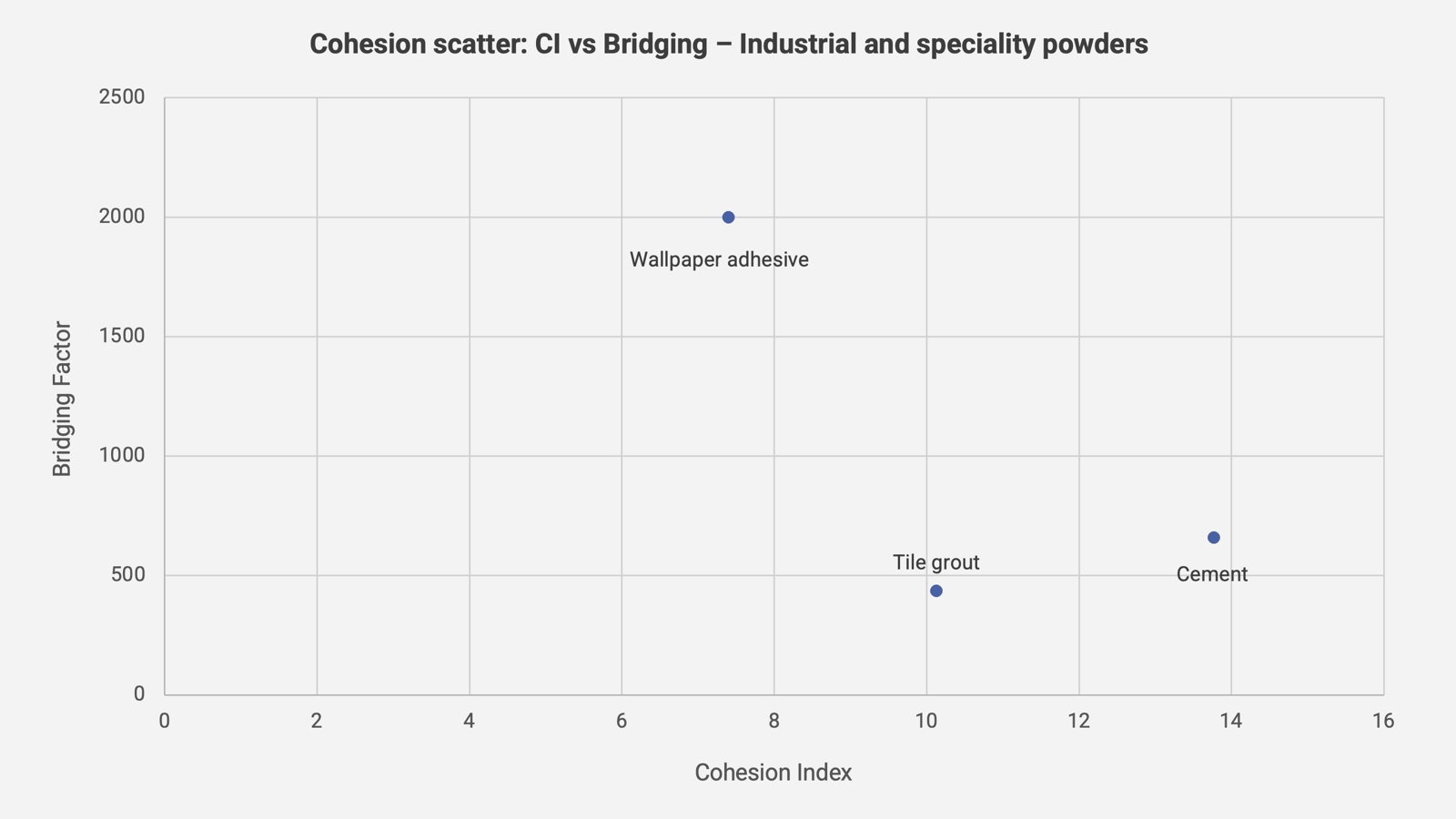 Cohesion scatter graph for three industrial samples
 PFSD trend lines: Compaction Coeff vs speed (10/20/50/100) for three industrial samples
 Caking comparison bars: Mean Cake Strength and Cake 5 Height Ratio for three industrial samples
Reading the results: three contrasting powder stories
- Wallpaper adhesive is the most instructive sample on this page for understanding the limits of single-parameter flow classification. Its Cohesion Index is low (7.40) which by a simple flowability rating would suggest an easy-flowing material presenting few handling problems. But the other parameters tell a completely different story: a Bridging Factor of nearly 2000, a compaction coefficient at low speed that is the highest of any sample across all seven industry pages, a mean cake strength over 500g, and a cake height ratio of 0.93 meaning the powder column has almost completely consolidated under load. The practical message is that low cohesion does not mean low risk. For this material, the dominant failure modes are packing, bridging, and severe caking, none of which a cohesion index alone would predict.
- Cement and Tile grout occupy a more similar and moderate band across all parameters: both show moderate cohesion and bridging, both become substantially easier to move as speed increases (speed ratios around 0.35-0.36), and both produce moderate cake strengths in the 115-125g range. They are not, however, identical: cement shows slightly higher cohesion and higher bridging than tile grout, and its compaction coefficient at low speed is marginally higher, consistent with a finer and more angular particle morphology. For both materials, the handling story is one of manageable flow when the powder is in motion but meaningful consolidation risk during shutdown, storage, or restart – the combination that most commonly drives unexpected downtime in industrial powder handling.
Recommended test approach
Powder Flow Analyser – dynamic behaviour
|
Typical issue |
Recommended test |
Insight provided |
Why it matters |
|
Supplier-to-supplier variability |
Bulk Density / Cohesion |
Differences in packing and inter-particle attraction |
Ensures consistent processing across suppliers |
|
Hopper or feeder discharge problems |
Cohesion (1 speed) |
Bridging and sticking tendency |
Reduces downtime and process interruptions |
|
Sensitivity to processing speed |
Cohesion (4 speeds) |
Speed-dependent flow behaviour and stability |
Improves scale-up and process robustness |
|
Pneumatic or high-speed conveying failures |
Powder Flow Speed Dependence (PFSD) |
Aeration, compaction, and attrition sensitivity |
Critical for reliable conveying system design |
|
Consolidation during storage or shutdown |
Consolidation and Caking |
Strength gain and resistance to restart |
Prevents flow failure after downtime |
Texture Analyser – strength and weaknesses
|
Typical issue |
Recommended test |
Insight provided |
Why it matters |
|
Cake hardness after storage or shutdown |
Cake Break test |
Mechanical strength and breakability of consolidated powder |
Determines ease of restart and whether manual intervention will be needed |
|
Compaction and densification behaviour |
Uniaxial Compression |
Powder bed stress–strain response and yield point |
Relevant to compaction, briquetting, granulation, and pelletisation processes |
|
Granule or pellet robustness |
Penetration/Hardness |
Force required to fracture or crush individual granules |
Supports quality control of manufactured granules and coated particles |
Powder problems are driven by movement, stress, and time. Dynamic flow and strength-based testing reveal behaviours that static tests cannot capture.
See more powder application areas


